Sunsets get later. Why are the days still getting shorter?
A later sunset can hide a shrinking day. Three dates, a small calculation and the surprising drift of solar noon reveal why winter has more than one turning point.
The evening gives you the wrong clue
There is a small piece of good news hidden before the northern winter solstice. In many places, sunset has already stopped getting earlier. You can gain a few minutes at the end of the afternoon while the total amount of daylight is still shrinking.
That sounds like a mistake in the calendar. If the shortest day is still ahead, how can the evenings be recovering?
The missing clue is at the other end of the day. Sunrise is moving too. But that only explains the arithmetic. The stranger part is why the two ends refuse to turn around together.
Three dates, one city
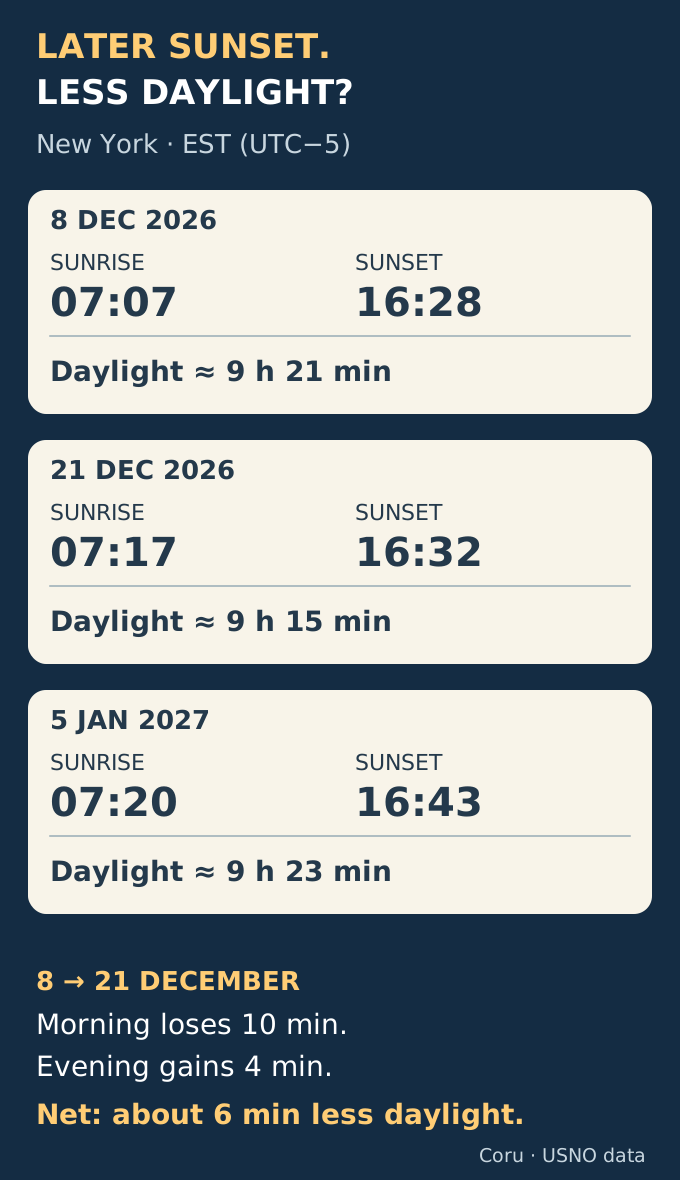
Take New York at 40.7128° N, 74.0060° W. The US Naval Observatory gives these calculated times, all in Eastern Standard Time, UTC−5:
- 8 December 2026: sunrise 07:07, sunset 16:28 — about 9 hours 21 minutes between them.
- 21 December 2026: sunrise 07:17, sunset 16:32 — about 9 hours 15 minutes.
- 5 January 2027: sunrise 07:20, sunset 16:43 — about 9 hours 23 minutes.
Follow the minutes
Between the first two dates, sunset moves four minutes later. Sunrise moves ten minutes later. The morning loses more than the evening gains, so the daylight interval shrinks by about six minutes.
Now look at the last two dates. Sunrise is still three minutes later on 5 January, but sunset has gained eleven minutes. This time the evening wins: there are about eight more minutes between sunrise and sunset.
These are sample dates, not a claim that 8 December and 5 January are the exact turning points. The times are rounded to minutes, so the durations and differences are approximate. Still, the contradiction has disappeared: a later sunset tells you where daylight ends, not how much daylight there is.
Imagine daylight as a strip of paper
Put a paper strip across a clock scale, with its left edge at sunrise and its right edge at sunset. Its width represents the daylight interval.
You can change two things independently. Shorten the strip, and its edges move inward. Slide the whole strip to the right, and both edges move later. Do both at once, and the right edge can move later even while the strip gets narrower.
The seasonal change in the Sun’s path controls the shrinking. As the Northern Hemisphere approaches its winter solstice, the Sun takes a lower, shorter route across the sky. Near the turning point, the day-to-day change in daylight becomes small.
Meanwhile, the strip is sliding. The clue is solar noon: the moment the Sun crosses your local meridian, an imaginary north–south line in the sky. In New York, its calculated clock time moves from 11:48 on 8 December to 11:54 on 21 December, then 12:01 on 5 January. Noon itself has slipped thirteen minutes along the clock.
Solar noon is only approximately halfway between sunrise and sunset. The paper strip is a way to separate two effects, not an exact sunrise calculator.
Why noon refuses to sit still
Our clocks give each ordinary day the same 24 hours. The interval from one solar noon to the next is slightly variable. In late December it can be nearly half a minute longer than 24 hours. A tiny daily delay adds up.
Earth’s rotation is only part of the story. While our planet turns, it also travels around the Sun. After a complete turn relative to the distant stars, it must turn a little farther to bring the Sun back across the same meridian.
That extra amount is not constant. Earth’s orbit is slightly elliptical, so its orbital speed changes through the year. Its tilted axis also changes how the Sun’s apparent yearly motion translates into east–west motion across the sky. Both effects matter; an elliptical-orbit explanation alone leaves out part of the mechanism.
Astronomers describe the changing difference between apparent solar time and mean solar time as the equation of time. You do not need to solve it to understand this winter puzzle. Around December, solar noon shifts later by the clock, carrying sunrise and sunset later with it.
Winter has more than one turning point
At northern middle latitudes, three milestones usually arrive in sequence: the earliest sunset, the shortest daylight interval around the December solstice, and the latest sunrise. They answer three different questions: When does daylight end earliest? When is there least of it? When does it begin latest?
The gaps depend on latitude. There is no single earliest-sunset date for the whole Northern Hemisphere. The Southern Hemisphere has its winter solstice in June, so do not transplant New York’s December calendar there. Polar day and night need their own treatment: a date without sunrise or sunset cannot fit this three-clock example.
Nor is this a daylight-saving trick. All three New York examples use the same UTC−5 offset. Moving a clock changes the labels on both ends; it does not create or remove sunlight.
Catch the shift where you live
Open a sunrise-and-sunset table for your own location. Around your winter solstice, compare dates about a week apart. Write down sunrise, sunset and their difference. Add the solar-noon column if the table provides one.
A week is easier to compare than adjacent dates, whose rounded minute values may look identical. Keep the same time convention, especially across a clock change. Use a table to see the astronomical pattern; buildings, hills and variable atmospheric conditions can change what you actually see from a window. Sunset also does not mean instant darkness: twilight continues afterward.
Then watch for the two reversals. First, the evening starts giving time back while the morning still takes more. Later, daylight begins growing even though mornings have not yet reached their latest start.
Winter’s first longer evening is real. It just arrives before the shortest day.
Sources & further reading
- Make a sunrise and sunset table for your location (USNO)
- US Naval Observatory: sunrise and sunset near the solstices
- US Naval Observatory: the equation of time
- US Naval Observatory: rise, set, transit and twilight definitions
- Royal Observatory Greenwich: the winter solstice
- USNO calculated data: New York, 8 December 2026, EST
- USNO calculated data: New York, 21 December 2026, EST
- USNO calculated data: New York, 5 January 2027, EST