Why can you see the Moon during the day?
The Moon can be above your horizon while the Sun is up. Its surface reflects sunlight, and it can be bright enough to stand out against the blue sky. Daylight does not switch the Moon off: whether you notice it depends on where it is and how clearly you can see it.
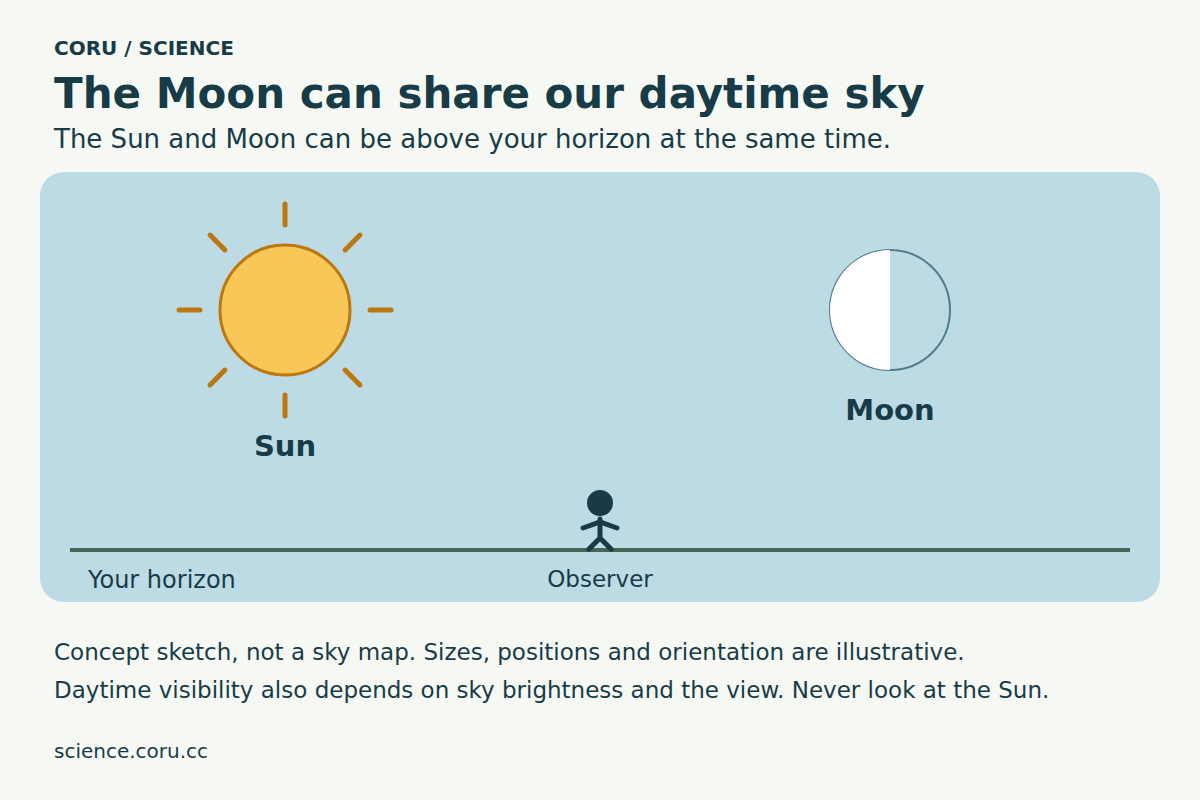
Two questions explain a daytime Moon
First: is the Moon above your local horizon? The Sun and Moon do not take turns occupying the sky. As Earth rotates and the Moon moves around it, they can both be above the horizon at once.
Second: can you pick the Moon out against the sky? A visible part of its sunlit surface must stand out, with a clear line of sight. Cloud, haze, buildings and bright sky can prevent you from spotting it even when it is above the horizon. NASA’s daytime-Moon explanation makes this useful distinction between being in the sky and being noticeable.
When is it worth looking?
For a first attempt, try an afternoon near first quarter, or a morning near last quarter. These are broad patterns from NASA’s phase guide, not a timetable for your location.
- First quarter: about half the disk looks lit; the Moon generally rises around midday and remains up through the afternoon.
- Last quarter, also called third quarter: about half the disk looks lit; the Moon generally remains up after sunrise and sets around midday.
- Near full Moon: the Moon is roughly opposite the Sun. It typically rises around sunset and sets around sunrise, so the middle of the day is a poor starting choice.
- New Moon: its sunlit side faces mostly away from us and it is close to the Sun in the sky. Do not try to search near the Sun.
Why the calendar is only a starting point
The exact times depend on the date and your location. The U.S. Naval Observatory describes full-Moon rising and setting as approximate for most places. A nearly full Moon can still be visible before sunset or after sunrise; “a full-looking Moon is never visible by day” is too strong.
If you need a particular session, check local moonrise and moonset predictions for that date. A forecast that puts the Moon above the horizon still cannot guarantee a clear view. You can also start with a Moon you happen to notice, without planning a session.
What about people on the other side of Earth?
Night does not guarantee a view of the Moon. Someone elsewhere may have it below their horizon, even while you can see it in daylight. People who can see it at the same moment see essentially the same phase, although its orientation can look different. The part that looks dark to you is not a separate bright piece reserved for another country.
A crescent is not Earth’s shadow
Ordinary phases come from our changing view of the Moon’s sunlit half. The Moon stays spherical while the visible lit portion changes. Earth’s shadow reaches the Moon during a lunar eclipse; it does not make the everyday crescent.
“Quarter” describes a stage in the phase cycle, even though roughly half the disk appears lit. Do not use which side looks bright in this illustration as a universal direction rule: the Moon’s apparent orientation depends on where and when you look.
Try four short observations
You need only your eyes and somewhere to write. Do not look at the Sun. Leave binoculars and telescopes out of this daytime activity; choose a comfortable view well away from the Sun.
- 1. Stop in a safe place with an open view, or use a suitable window. Record the date, local time and place.
- 2. Note the conditions: clear gaps, cloud, haze, or roofs and trees blocking part of the view.
- 3. Write “visible” or “not found”. If visible, describe the lit shape in ordinary words or sketch it. You do not need to know its phase name.
- 4. Keep a separate question: “Was it hidden by the cloud?” is a possibility, not an observation.
- 5. Try again at a similar local time on several days, if convenient. Four spaces on the sheet are a starting record, not a promise of four sightings or a complete lunar cycle.
Download the four-observation sheet (A4 PDF)
One page with four spaces for notes or sketches. Print using Fit to page; exact scale does not matter. A notebook works too.
An example record — invented, not a sky forecast
Date: write the date you observe. Local time: 16:10. Place: the courtyard. Conditions: blue gaps between clouds; roof blocks the lower part of the view. Result: visible. Shape: a pale disk with roughly half lit. Question: will I find it in the same place at this time tomorrow?
This record supports “I saw the Moon in daylight.” It does not establish an exact phase or a future position. If your next entry is “not found; cloud across the view”, keep that result. It does not show that the Moon vanished or was below the horizon.
What to compare afterwards
Compare the recorded shapes, times and viewing conditions. Mark a pattern as tentative if you have only a few sightings. If every attempt was cloudy, the record says more about your view than about the Moon.
For a longer project, NASA JPL’s Observing the Moon lesson uses observations across at least a month. Our four-entry sheet is a smaller starting activity. The complete instructions are above; a plain notebook works just as well as the PDF.