Why does thin ice sound like a laser gun? The physics of singing lakes
Thin, clear lake ice is a stiff plate floating on water. Strike it and the high pitches race ahead through the bending ice, so a click can reach a distant listener as a falling “pew”; where the bending wave keeps pace with sound in air, the ice also rings a steady note. Its pitch tracks thickness: researchers in Norway read about 725 hertz in a National Geographic skating film as ice about 4.3 centimetres thick, and a later single-microphone study found thicknesses from the tone typically within 5 to 10 per cent of those measured in drilled holes. No sound proves that ice is safe.
A blaster on the lake
Skip a stone across a frozen lake and, if the ice is thin enough, it does not clink. It goes “pew”, a falling electronic chirp that NPR compared to a Star Wars blaster after a video of a newcomer to Alaska skipping rocks on a frozen lake went viral. Swedish wild skaters hear such laser-like sounds under their blades. In 2018 National Geographic published a short film, cited by researchers as “How Skating on Thin Ice Creates Laser-Like Sounds”, in which the Stockholm photographer and filmmaker Henrik Trygg recorded the mathematician Mårten Ajne skating on 45-millimetre ice on Lissma Kvarnsjö, a lake outside Stockholm.
Its soundtrack became a small scientific case: researchers in Norway used it to illustrate how the thickness of ice can be read from its sound, and a referee of their paper heard something else in it. The “pew” turns out to have a precise explanation, and the note the ice sings even says how thick it is. What it cannot tell you is whether the ice will hold you.
A plate that bends
As Live Science put it in a 2014 explainer, “lake ice acts like a vibrating plate”: a stone’s impact “launches a bending wave (also called a flexural wave) in the ice”, and the bend runs outward like a ripple. Rowan Romeyn and colleagues in Tromsø and Bergen, who later analysed the skating film, model it the same way: a thin elastic plate on water.
Bending waves have an unusual habit: their speed depends on their pitch, and higher pitches travel faster. The pace is set by the plate’s bending stiffness, which grows with the cube of its thickness, so ice twice as thick is eight times as stiff, and by the water underneath, which has to move with the ice; in the model of a 2010 study of river ice, that extra load lowers the speed but keeps the rule that high pitches outrun low ones.
High notes first
A stone hitting ice makes a click that contains a whole range of pitches at once. In the ice the high pitches pull ahead, so by the time the wave reaches someone some way off, the click has become a falling sweep, longer the farther away you are. “It takes distance for the higher frequencies to outrun the lower frequencies,” Mark Hamilton, a professor of acoustics at the University of Texas, Austin, told Live Science; stand too close and all you hear is a simple crack.
That falling sweep is exactly what a referee heard in the National Geographic film. Ludovic Moreau, who reviewed Romeyn and colleagues’ 2021 paper for the journal The Cryosphere, extracted the audio, analysed its time-frequency spectrum around the eight-second mark and wrote that the sounds “have a very dispersive nature, with the high frequencies arriving before the low frequencies. This is what produces the famous laser-like sounds.” He put them down to “the flexural wave leaking in the air”.
The same ordering has been measured inside ice. In a 2010 paper in the Russian journal Akusticheskii Zhurnal, Yu. M. and V. Yu. Zaslavsky struck river ice 25 to 50 centimetres thick with a falling weight and recorded the vertical motion of the ice surface with a geophone. In the bending wave, pitches of about 50 to 100 hertz arrived first and those of 20 to 30 hertz last. But its group speed, the speed of its energy, was only about 180 to 250 metres per second, so on that thick ice it came after the clap through the air, which travelled at about 330 to 340. It is the ordering of pitches inside the ice, not a recording of the “pew”.
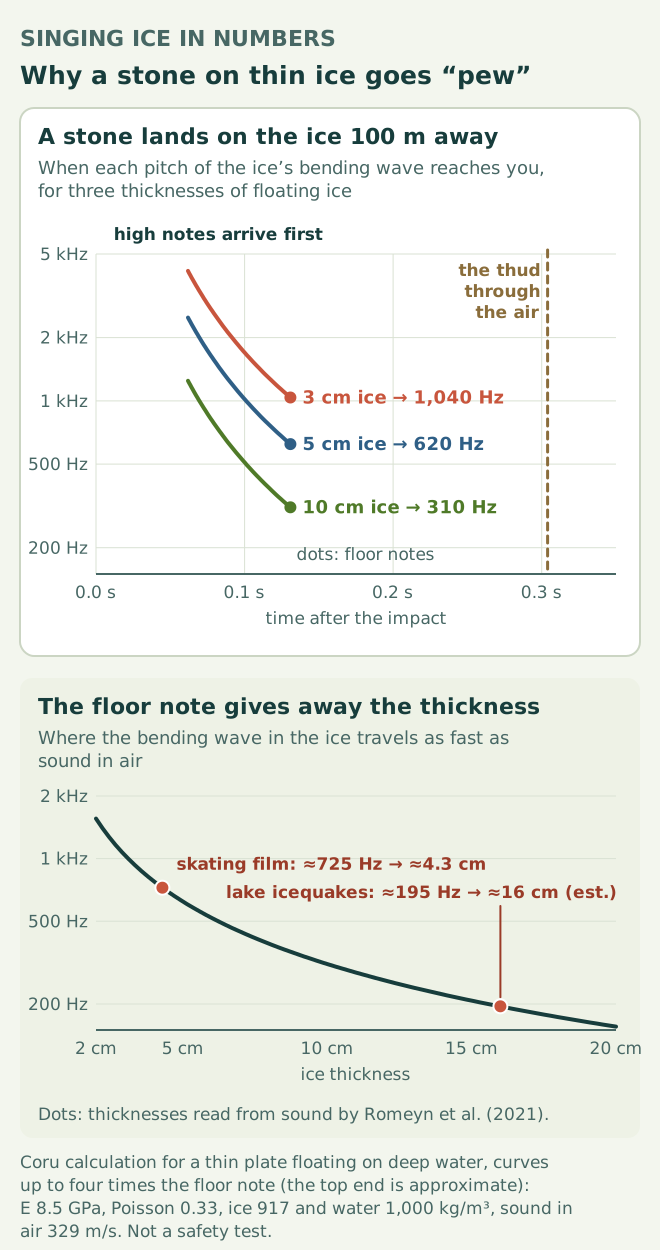
On thin ice, our own calculation says, the bending wave wins its race with the air. We took the floating-plate equation with the lake-ice constants Romeyn and colleagues used in 2021 (a Young’s modulus, the stiffness of the ice itself, of 8.5 gigapascals; Poisson’s ratio 0.33; ice of 917 and water of 1,000 kilograms per cubic metre; sound in air at 329 metres per second, its speed at −3.9 °C), assumed deep water and asked when each pitch from a stone landing 100 metres away reaches a listener. For ice 3, 5 or 10 centimetres thick, the figure below shows the highest pitches we drew, four times the floor note described next, arriving after about 0.06 seconds and the sweep ending on the floor note at about 0.13 seconds; the thud through the air comes only at 0.30 seconds. The whole chirp is over before the stone’s own thud reaches you.
Two choices are ours. The curves end at the floor note because, on our reading of the phase-matching condition Romeyn and colleagues describe, the slower waves below it send little sound into the air; and they stop at four times the floor note, where the simple plate equation is already stretched, so the earliest arrivals drawn are approximate.
The floor note
The same physics hides a second sound. At one pitch the crests of the bending wave travel exactly as fast as sound in air; there sound passes from the ice into the air most efficiently, and a strike leaves a steady tone ringing. We call it the floor note, because in our calculation the falling sweep ends on it. Romeyn and colleagues call the tone an air-coupled flexural wave and describe wave trains “of constant frequency that arrive in advance of the direct air wave”. The tone arrives ahead of the thud through the air because a bending wave’s energy runs faster than its crests: at the floor note, in our calculation, about 2.3 times as fast as sound in air.
Thickness controls the bending stiffness so strongly that thinner ice sings a higher note. Romeyn and colleagues’ paper is mostly about Svalbard sea ice (240 hertz on ice about 20 centimetres thick, 60 on ice of about 80); for lake ice it gives two readings. In the National Geographic film the steady tone in the scene from 16 to 33 seconds sits at about 725 hertz, which with their lake-ice constants means ice about 4.3 centimetres thick, in line, they note, with the thickness presented in the film. On 3 January 2021 they recorded natural icequakes on Storvatnet, a lake on Kvaløya in Norway, with a camera’s built-in microphone: a tone of about 195 hertz, and ice of about 16 centimetres by their calculation. That ice was not drilled; they had estimated it at 10 to 20 centimetres from the cracks running down through the clear, black ice.
In a 2023 paper, Romeyn and Alfred Hanssen took a single, inexpensive microphone to three frozen lakes in the Tromsø region. According to its abstract, the steady tone was a robust feature of the struck lakes, and thicknesses worked out from it were typically within 5 to 10 per cent of those measured in holes drilled near the microphone, for hammer strikes, jumps, skate taps and natural ice quakes alike, with the microphone on the ice, on the shoreline or in the hand. The abstract adds that they recorded the chirp too, best with the microphone resting on the ice, and used its spread in time to work out the distance to the source.
Our calculation turns this into a rule of thumb: with the lake-ice constants above, the floor note in hertz is about 31 divided by the thickness of the ice in metres. That gives about 1,040 hertz for 3 centimetres, 620 for 5 and 310 for 10, the dots in the upper chart of the figure. Run backwards, it returns the published readings, 725 hertz for 4.3 centimetres and 195 for 16, both marked in the lower chart. It holds only for a thin, uniform plate on deep water with the assumed Young’s modulus, which, the 2023 abstract notes, an observed ice type or a drilled thickness can constrain; the 2021 paper calls its results “effective thicknesses”. Air temperature matters too: between −20 and +2 °C the speed of sound changes from 318 to 332 metres per second, enough, Romeyn and colleagues calculate, to shift the tone by about 8 per cent.
So is the film’s laser sound a steady tone or a falling chirp? Romeyn and colleagues called the skaters’ sounds tones of the air-coupled wave; Moreau heard a chirp, “not an air-coupled flexural wave, but simply a flexural wave”, and asked them to drop the comparison. They were not looking at the same seconds: the spectrogram in the published paper covers 16 to 33 seconds, while Moreau zoomed in around the eighth, after judging the sounds “just by listening to them”. The authors kept the example, adding a waveform panel and naming the segment they had analysed. Neither side proved the other wrong, and the lake study does not settle the argument about the film; but its abstract reports both sounds on the same lakes.
Lakes that boom by themselves
Because ice creeps, a 2010 conference paper from VTT Technical Research Centre of Finland explains, high thermal stresses build up in it only when the temperature changes fairly fast. Cooling opens cracks that fill with water and may freeze over, and rapid warming then makes the expanding ice fail at the refrozen crack. Snow on the ice “will significantly reduce the tendency of thermal cracking as it is a very efficient insulator”, so the paper expects cracking above all in late autumn, while the ice is new, and in spring.
On the night of 1 January 2018, three lakes in Alberta, Canada, produced some of the largest lake icequakes yet reported, of local magnitude about 2. In the 24 hours before the 23:06 event on Lac Ste. Anne, the air at the nearest weather station warmed from −29.4 °C to −0.7 °C, a rise of 28.4 °C. Residents were woken by “loud boom/popping sounds”, and overnight a ridge of ice 1 to 2 metres high rose along the shore of Pigeon Lake. Jeffrey Kavanaugh and his co-authors conjecture that the ice failed suddenly as it expanded, an expansion made worse by the lack of insulating snow; in their model of one day of such warming, 30 centimetres of snow cuts the expansion of a 5-kilometre stretch of ice from 3.1 metres to 0.4.
Falling temperatures crack ice too. On Kråkskarvatnet near Tromsø on 2 December 2022, the field notes in Romeyn’s dataset record the air dropping from −2 to −4.5 °C over 60 to 90 minutes and “A lot of icequake activity, likely related to falling temperatures, freezing of water and/or differential thermal contraction cracking of upper ice layer”.
Why black ice is black
Skaters call the new, smooth ice they chase black ice, though it is transparent and, as Scientific American notes, unrelated to the black ice of roads. The US Army Corps of Engineers’ ice-engineering manual explains the name: when columnar ice is translucent or transparent, “it is called black ice, because it is dark in appearance and has a very low albedo in comparison to snow or white ice”. It can reflect as little as 0.2 of the sunlight, against 0.6 to 0.8 for white snow ice and 0.9 for fresh snow; you look through it into the dark water below.
Black ice grows from below as the lake’s heat escapes up through it. In the simplest case, the manual’s “classic result” is that “the ice thickness is proportional to the square root of the accumulated freezing degree-days”, the running total of degrees of frost since freeze-up, so four times the cold buys only twice the ice; snow on top slows growth further.
Clear ice is usually the strong ice: Parks Canada says “Clear blue ice is strongest” and white opaque ice is half as strong. But black ice also soaks up spring sunshine, partly because of that low albedo: on the Liard River in northern Canada, the manual reports, the compressive strength of columnar ice fell from about 19 to 10 megapascals over 14 days in April while white ice held at about 17. And despite a skater’s remark to National Geographic that black ice “doesn’t expand and contract”, the evidence above points the other way: Romeyn and colleagues suggest that thermal expansion caused the Storvatnet icequakes in clear, black ice.
Not a safety test
The ice that sings under skaters is very thin: wild skaters chase newly frozen ice typically about 4 to 5 centimetres thick, by Romeyn and colleagues’ account, and the film’s ice was 45 millimetres. Every official minimum for walking that we checked is thicker.
Nor can you hear safety. The pitch gives a thickness only through a calculation that assumes the ice’s stiffness and the air temperature, and the 2023 abstract calls recording the tone with a microphone “a promising additional tool for evaluation of ice conditions”. A true thickness is not enough either. The Minnesota Department of Natural Resources warns: “You can’t judge ice conditions just by appearance or thickness.” Silence proves nothing: Russia’s emergencies ministry warns that milky, grey, porous ice collapses without a warning crackle. Even Ajne, asked by National Geographic whether he ever really knows if the ice is totally safe, said: “With experience you get better and better at it, but you’re never certain.”
The researchers’ own goal points the same way: one attraction of their method, Romeyn and colleagues wrote, is “the fact that a microphone could be placed on land when the ice is too thin to safely traverse”. Here is what the issuers we checked say, mostly for one person on foot; they disagree, and none of their numbers is a universal safe thickness.
- Minnesota Department of Natural Resources, United States: 4 inches (about 10 centimetres) of new, clear ice on foot, keep off anything thinner, and double the guidelines for white ice; its poster is headed “ICE IS NEVER 100% SAFE”.
- Parks Canada, Banff National Park: “The recommended ice thickness is 15 cm for walking or skating alone and 20 cm for skating parties or games.” It “does NOT monitor natural ice surfaces for safety or mark potential hazards”.
- Sweden’s Ice Safety Council, in a press release of the Swedish Life Saving Society: without very great experience of ice, stay off ice thinner than 10 centimetres; expert long-distance skaters sometimes go thinner, but that is not recommended for the public, and the first black, crack-free ice is very hard to judge for thickness without a tool.
- Finland’s Swimming Teaching and Lifesaving Federation (SUH): at least 10 centimetres of clear ice under an adult walking alone; frosty weather and the date on the calendar do not guarantee that ice is safe.
- Russia’s emergencies ministry (МЧС России): at least 7 centimetres for one person, 12 to build a skating rink and 15 for a crossing on foot. The only safe ice is ice you have checked yourself, and on thin, crackling ice you should turn back carefully.
Listen from the shore
You can listen from the shore, where the researchers say a microphone can go when the ice is too thin to cross. From there you will mostly catch the steady tone: the 2023 study recorded the chirp best with the microphone resting on the ice.
- On a still, frosty day, stand on the shore of a lake with new, clear ice and listen when skaters cross it, or when the air is cooling and the ice cracks by itself.
- Record with a phone and open the file in a free spectrogram app, which draws pitch against time. A distant crack or skate stroke may show as a level line, the floor note; our calculation predicts a falling curve that ends on it, though from the shore that chirp is harder to catch.
- Read the pitch of the level line against the lower chart of the figure: a rough thickness under our assumed constants, off by several per cent with air temperature alone, and never a verdict on whether the ice will hold anyone.
- Whatever you hear, do not walk onto the ice for a better recording. The shore is the right place for the microphone.
Sources & further reading
- Romeyn R., Hanssen A., Ruud B. O., Johansen T. A. Sea ice thickness from air-coupled flexural waves. The Cryosphere, 2021, 15:2939–2955
- Moreau L. Referee comment RC3 (supplement) on the discussion paper tc-2021-71, Elastic properties of floating sea ice from air-coupled flexural waves. The Cryosphere Discussions, 2021
- Romeyn R. et al. Author’s response (AR1) to the referees of tc-2021-71. The Cryosphere Discussions, 2021
- Romeyn R., Hanssen A. Microphone recording of flexural waves for estimation of lake ice thickness. Cold Regions Science and Technology, 2023, 211:103875 (abstract; OpenAlex record)
- Romeyn R. Replication Data for Microphone recording of flexural waves for estimation of lake ice thickness. DataverseNO, 2023, doi:10.18710/C2ONEX (dataset record with the paper’s abstract)
- Romeyn R. Field notes, Kråkskarvatnet, 2 December 2022. DataverseNO dataset doi:10.18710/C2ONEX
- Zaslavsky Yu. M., Zaslavsky V. Yu. Experimental analysis of flexural waves on river ice (Экспериментальный анализ изгибных волн на речном льду). Akusticheskii Zhurnal, 2010, 56(4):483–490
- Wikipedia (English). Lamb waves
- Makkonen L., Törnqvist J., Kuutti J. Vibrations of buildings induced by thermal cracking of lake ice. 20th IAHR International Symposium on Ice, Lahti, Finland, 2010
- Kavanaugh J., Schultz R., Andriashek L. D., van der Baan M., Ghofrani H., Atkinson G., Utting D. J. A New Year’s Day Icebreaker: Icequakes on Lakes in Alberta, Canada. Canadian Journal of Earth Sciences, 2019, 56(2):183–200 (accepted manuscript)
- US Army Corps of Engineers. Engineering and Design: Ice Engineering. Engineer Manual EM 1110-2-1612, 30 October 2002, with later changes (copy hosted by the ASDSO Dam Safety Toolbox)
- Wikipedia (Swedish). Kärnis
- Minnesota Department of Natural Resources. Recommended Minimum Ice Thickness (Guidelines for New, Clear Ice Only). Poster ENF_0006_2023
- Minnesota Department of Natural Resources. Danger! Thin Ice. Brochure ENF_0017_26, 2026
- Parks Canada. Ice skating – Banff National Park
- Svenska Livräddningssällskapet / Issäkerhetsrådet. Nu lägger sig isarna. Press release, Mynewsdesk, 16 November 2017
- Suomen Uimaopetus- ja Hengenpelastusliitto (SUH). Jääturvallisuus (slides; kotitapaturma.fi upload of January 2025)
- МЧС России. Правила поведения на льду и выезд на переправу (EMERCOM of Russia: rules of behaviour on ice)
- Rankin A. How Skating on Thin Ice Creates Laser-Like Sounds. National Geographic, 30 January 2018
- Oskin B. Pew, Pew: Bizarre Sounds from Frozen Lake Explained. Live Science, 16 October 2014
- Cole A., Shapiro A. Why Does A Frozen Lake Sound Like A Star Wars Blaster? NPR, All Things Considered, 21 December 2016 (transcript)
- Griffin J. The Magic (and Math) of Skating on Thin Ice without Falling In. Scientific American, 12 March 2018 (reprinted from PBS NewsHour, first published 9 March 2018)