Why do fingers wrinkle in water? A nerve signal, not a sponge
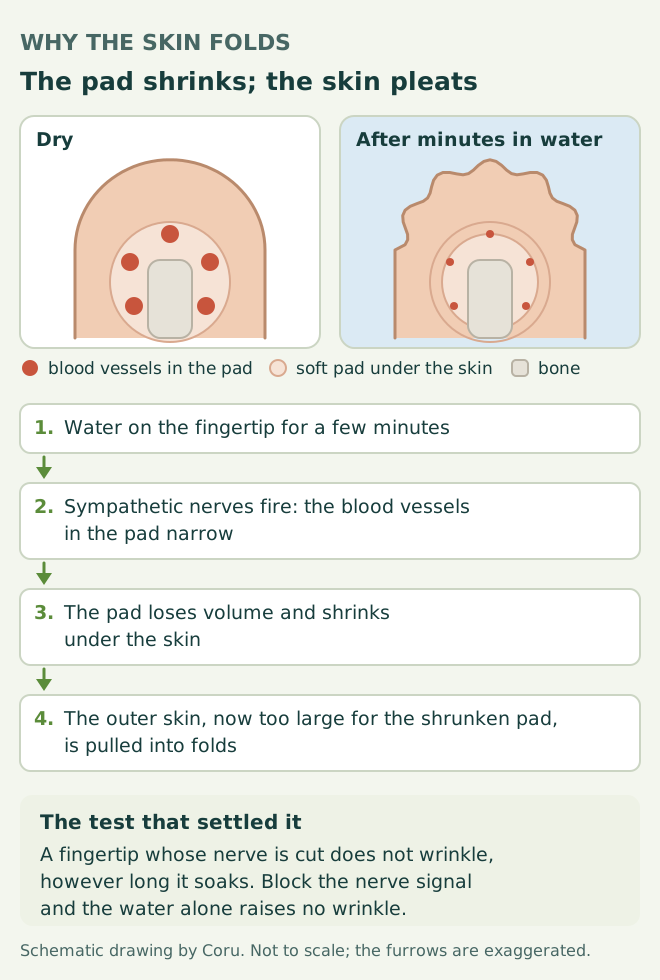
Fingertips do not wrinkle because the skin soaks up water: a fingertip whose nerve has been cut stays smooth however long it soaks. Water entering through the sweat ducts is thought to trigger a sympathetic nerve signal, the small vessels of the fingertip pad constrict, the pad loses volume and the skin above it is pulled into folds. The article follows the experiments behind this, the thirty-minute clinical test built on it, the three studies that disagree about whether wrinkles improve grip, the 2025 finding that the pattern repeats, and a two-bowl experiment to try at home.
The sponge that isn’t
Twenty minutes in the bath and your fingertips look like dried apricots. Everyone knows why: the skin soaks up water, swells and buckles. It is a tidy explanation with one problem. A fingertip whose nerve has been cut does not wrinkle, however long it soaks. Water alone does not wrinkle it. The wrinkles are something the body does, actively, through a nerve.
Doctors noticed this first. In the 1930s, as later papers recount, Lewis and Pickering described patients with a damaged median nerve whose fingers no longer wrinkled, which pointed to the nervous system as the central player. In 1973 Seamus O’Riain turned the observation into a tool, describing in the British Medical Journal a simple objective test of nerve function in the hand by immersion in warm water, with results that corresponded to what was found at operation. If the wrinkles came back, the repaired nerve was working. O’Riain wrote of sensory nerves; within a few years the test was being described as a test of the sympathetic fibres, the involuntary nerves that travel alongside the sensory ones, and that is the thread the rest of this story follows.
What actually happens in the fingertip
The chain of events was pieced together in Singapore in 2003 and 2004 by the neurologist Einar Wilder-Smith and colleagues. Some of its links were measured and some inferred; here it is as he proposed it.
Water gets into the outer layer of skin through the sweat ducts, of which the palms and soles have a great many. That shifts the balance of salts in the epidermis. The dense network of nerve fibres there responds by firing harder, and the sympathetic nervous system, the part that also makes you blush or go pale, orders the small blood vessels of the fingertip pad to narrow. Measurements of blood flow velocity in healthy volunteers showed it falling in the ulnar and digital arteries and in the skin of the fingertip while the wrinkles formed, most of all in the vessels of the digit itself. The authors’ conclusion: “water-immersion wrinkling is a function of digit pulp vasoconstriction.”
With less blood in it, the soft pad under the skin loses volume. The pressure inside the pulp drops, in this account, and pulls the overlying skin downwards, and the skin, which has not shrunk, is distorted into folds. A dried grape becomes a raisin for the same reason: it has lost more volume than surface.
Two experiments pinned the vasoconstriction down. In 25 healthy volunteers, a patch of EMLA, an anaesthetic cream that constricts vessels, applied to the fingertip produced nearly the same wrinkle scores and drop in digit blood flow as water immersion, while a plain aqueous cream produced minimal wrinkling. And in 20 fingers that had been completely severed and surgically replanted, on average a year and a half earlier, laser Doppler imaging showed that warm saline cut blood flow in the normal fingers of the other hand by about 28 per cent and wrinkled them, while in the replanted fingers, whose nerve supply had been cut, blood flow actually rose by about 23 per cent and the skin stayed smooth.
A nerve test in a bowl of warm water
Because it depends on a working sympathetic nerve, the wrinkle test is still used in clinics. The standard version is thirty minutes in water at about 40 °C, after which the folds on each fingertip are counted or graded. In a 1984 study of 100 healthy people and 42 with diabetes, wrinkling was markedly decreased in the diabetic group, and also, unexpectedly, in manual workers. In 18 patients with Parkinson’s disease affecting one side of the body, the hand on the less affected side produced far fewer ridges than the other hand or than healthy controls. In leprosy, which attacks the nerves of the hands, a 1985 report in a German dermatology journal found impaired wrinkling in six of seven patients. And in cystic fibrosis what is thought to be an exaggerated form, called aquagenic wrinkling of the palms, appears within minutes: after a five-minute dip in lukewarm water, 84 per cent of 51 children with the disease showed wrinkling over more than 30 per cent of the palm, against none of 25 controls.
The timing has been measured too. A 1997 hand-surgery study found that 40 °C is the best water temperature for the test and that wrinkling should appear in about three and a half minutes. A 2025 study in Brazil, which timed 24 healthy adults to a set grade of wrinkling, found room-temperature water took anywhere from 2.1 to 37 minutes. Warm water was faster, and so was distilled water, while an arm cuff that restricted circulation prevented wrinkling for the whole thirty minutes. Testing in the morning was faster than at night, 10.4 against 14.6 minutes, and an espresso half an hour earlier sped it up as well. Salt slows the whole process: a 2005 study of 28 hands found that the saltier the solution, the longer the wait, and in the Brazilian study a concentrated salt solution produced no wrinkles at all in thirty minutes, nor did iced water, oil or an alkaline bath.
What are they for?
If the body goes to the trouble of wrinkling on command, it is natural to ask why. In 2011 Mark Changizi and colleagues proposed that the wrinkles are rain treads: their pattern, they argued, has the geometry of a drainage network, channelling water away from the gripping surface the way tyre treads do.
The first test came in 2013. Twenty people at Newcastle University soaked both hands for thirty minutes in 40 °C water, then moved 45 objects, 39 glass marbles and six lead fishing weights, from one container to another, through a small hole, with thumb and forefinger. Wet objects took 17 per cent longer to move than dry ones, but with wrinkled fingers the wet transfer took 12 per cent less time than with smooth ones, and wrinkles made no difference to dry objects.
A year later a group at the Max Delbrück Center in Berlin repeated the experiment with twice as many participants and found no advantage for wet objects in either of its two groups of twenty, with wrinkled fingers slightly slower overall in one of them, and no change in touch acuity or in the sense of vibration either. Then in 2021 the psychologist Nick Davis measured something different in 546 people at the Science Museum in London, 516 of them analysed, who chose their own condition rather than being assigned to one: not speed, but how hard the fingers squeezed relative to the load they were holding. Wet, smooth fingers gripped a wet object harder than necessary; wrinkled fingers brought the grip force back down to the level needed for a dry object. So the score stands at two studies for a grip advantage, measured in different ways, and one careful null. Whether the wrinkles are an adaptation or a side effect of the nerve’s plumbing is still an open question, and the explainers that state the grip benefit as settled fact are ahead of the evidence.
The wrinkles come back in the same places
A 2025 paper answers a question from a young reader. After the biomedical engineer Guy German of Binghamton University wrote a children’s explainer on wrinkly fingers, a follow-up question stumped him, as the university tells it: do the wrinkles always form in the same way? In a paper published in 2025, he and his former student Rachel Laytin photographed volunteers’ fingertips after two separate immersions, overlaid the images and compared the orientation of matching wrinkles against randomly oriented controls; according to the university’s news release, the immersions lasted thirty minutes and were repeated at least a day later. The wrinkle patterns lined up: the same furrows return in the same places. The authors’ explanation follows from the mechanism: the vessels that pull the skin down do not move much, so the map of folds they draw is the same every time. German also told the university about an unplanned side observation: a student with median nerve damage in his fingers volunteered for the bath and produced no wrinkles at all, one person rather than a study, but the same thing Lewis and Pickering saw.
Try it at the sink
Half an hour, two bowls and a repeat tomorrow are enough to see most of this yourself. Keep the water comfortably warm, not hot, and stop at thirty minutes, which is the standard clinical duration. If your hands have reduced sensation, or you are running this with a child, have the temperature checked by another hand, another person or a thermometer: a hand that cannot feel heat cannot judge ‘comfortably warm’. Do not do this with broken skin. And a hand that is slow to wrinkle is not a diagnosis of anything: timings vary widely between healthy people, by time of day and after coffee, and manual workers wrinkle less. The clinical test is read by someone trained to grade it.
- Fill one bowl with warm tap water, about bath temperature, and another with the same water plus as much table salt as will dissolve. Put one hand in the fresh water and keep the other dry. Note when the first furrows appear on the fingertip pads: about three and a half minutes in the 1997 study at 40 °C, but at room temperature healthy adults took anywhere from two minutes to over half an hour to reach a set grade of wrinkling.
- Compare the two hands. The soaked fingertips go pale as well as wrinkled, because less blood is flowing through them; the dry hand stays as it was.
- Now put the dry hand into the salt bowl for the same length of time. The prediction from the 2005 and 2025 studies is that it will wrinkle much later or not at all.
- Photograph the wrinkled pads, dry off, and repeat the whole thing tomorrow. The wrinkles fade ten to twenty minutes after drying, as the 2013 study observed; compare the direction of the main furrows on each finger between the two days.
- If you want to test the grip claim, move a dozen wet coins from one plate to another with wrinkled fingers, then dry off, wait the ten to twenty minutes it takes the wrinkles to fade, and repeat with the same hand, timing each run; on the second day do the two runs in the other order, to cancel out any practice effect, as the published studies did. Expect at most a small difference, and write down what you get: the published results disagree.
What the studies do not settle
The exact trigger remains a hypothesis: the review that proposed the salt-balance signal calls it probable, not proven. The function is disputed, as above. Almost all of the measurements are on hands; the Newcastle authors suggested that wrinkled toes may give better footing on wet ground, but that has not been tested. And the folding itself, how a loss of pad volume turns into the particular ridges and valleys you see, has so far been studied mostly in computer models of the fingertip.
Sources & further reading
- O’Riain S. New and simple test of nerve function in hand. British Medical Journal, 1973, 3:615–616
- Changizi M., Weber R., Kotecha R., Palazzo J. Are wet-induced wrinkled fingers primate rain treads? Brain, Behavior and Evolution, 2011, 77:286–290
- Wilder-Smith E. P. V., Chow A. Water-immersion wrinkling is due to vasoconstriction. Muscle & Nerve, 2003, 27:307–311
- Wilder-Smith E., Chow A. Water immersion and EMLA cause similar digit skin wrinkling and vasoconstriction. Microvascular Research, 2003, 66:68–72
- Wilder-Smith E. P. V. Water immersion wrinkling: physiology and use as an indicator of sympathetic function. Clinical Autonomic Research, 2004, 14:125–131
- Hsieh C.-H. et al. Paradoxical response to water immersion in replanted fingers. Clinical Autonomic Research, 2006, 16:223–227
- Cales L., Weber R. A. Effect of water temperature on skin wrinkling. Journal of Hand Surgery (American volume), 1997, 22:747–749
- Tsai N., Kirkham S. Fingertip skin wrinkling: the effect of varying tonicity. Journal of Hand Surgery (British volume), 2005, 30:273–275
- Martimiano B. D. et al. Influence of physical, chemical, and sympathetic stimuli on water-immersion finger wrinkling. Skin Pharmacology and Physiology, 2025, 38:121–126
- Clark C. V. et al. Decreased skin wrinkling in diabetes mellitus. Diabetes Care, 1984, 7:224–227
- Djaldetti R. et al. Abnormal skin wrinkling in the less affected side in hemiparkinsonism: a possible test for sympathetic dysfunction in Parkinson’s disease. Biomedicine & Pharmacotherapy, 2001, 55:475–478
- Mende B. Fehlende Faltenbildung der Fingerkuppen im Warmwassertest bei lepromatöser Nervenschädigung. Zeitschrift für Hautkrankheiten, 1985, 60:1961–1964
- Arkin L. M. et al. High prevalence of aquagenic wrinkling of the palms in patients with cystic fibrosis and association with measurable increases in transepidermal water loss. Pediatric Dermatology, 2012, 29:560–566
- Braham J., Sadeh M., Sarova-Pinhas I. Skin wrinkling on immersion of hands: a test of sympathetic function. Archives of Neurology, 1979, 36:113–114
- Kareklas K., Nettle D., Smulders T. V. Water-induced finger wrinkles improve handling of wet objects. Biology Letters, 2013, 9:20120999
- Haseleu J., Omerbašić D., Frenzel H., Gross M., Lewin G. R. Water-induced finger wrinkles do not affect touch acuity or dexterity in handling wet objects. PLOS ONE, 2014, 9:e84949
- Davis N. J. Water-immersion finger-wrinkling improves grip efficiency in handling wet objects. PLOS ONE, 2021, 16:e0253185
- Laytin R., German G. K. On the repeatability of wrinkling topography patterns in the fingers of water immersed human skin. Journal of the Mechanical Behavior of Biomedical Materials, 2025, 165:106935
- Yin J., Gerling G. J., Chen X. Mechanical modeling of a wrinkled fingertip immersed in water. Acta Biomaterialia, 2010, 6:1487–1496
- Binghamton University news, 7 May 2025: Do your fingers wrinkle the same way every time you’re in the water too long? Research says yes
- German G. Why do fingers get wrinkly after a long bath or swim? A biomedical engineer explains. The Conversation, 28 August 2023