Why is it so quiet after a snowfall? The measurements behind the hush
The hush after a snowfall is three things at once, and acousticians have measured all of them. Fresh snow is 90 to 95 per cent trapped air, acoustically almost the same stuff as air, so sound slides in and is ground down in the pores; along the surface a pistol shot fades as the distance to the power 1.6 to 1.9 instead of about 1.1 over bare ground, and a frozen crust gives the noise back. Traffic goes quiet at the source: cars on dry snow-covered asphalt measured 4.5 dB quieter at 50 km/h in Vilnius, and there are fewer, slower cars. And under clouds, fresh snow makes the night sky 188 times brighter than a clear one, brighter than any full moon. The article follows the measurements from a Japanese rice field in 1954 to a New Hampshire field and a Berlin suburb, explains why falling flakes, underwater snowflake noise and cold air are not the reason, and ends with a three-morning listening experiment.
The morning after
The first morning after a heavy snowfall sounds wrong. The street is still there, the cars are still there, and yet the city sounds as if someone had turned it down. Most people have noticed it; most explanations stop at “snow absorbs sound”. That is true, but it is only a third of the story. Acousticians have been studying the hush since the 1940s and measuring it since the 1950s, with car horns on frozen fields, blank pistols fired across a snowy field and microphones at the kerb of a snowy street, and the numbers say that three things happen at once: the ground stops reflecting, the cars get quieter and fewer, and, if the clouds stay, the night gets strikingly bright. They also say which popular explanations are not supported by any measurement.
A floor made of air
Fresh, uncompacted snow is mostly air: typically 90 to 95 per cent of it, trapped between the crystals, according to the US National Snow and Ice Data Center. For sound, that makes it a porous absorber, like the foam in a recording studio, and a thick one. The physics was worked out in laboratories long before the explainers. In 1965 Tamotsu Ishida of Hokkaido University published forty pages of measurements made in impedance tubes at temperatures between 0 and −15 °C, on new snow with a density of 0.09 to 0.13 grams per cubic centimetre and on compact snow two to four times denser. Compact snow ten centimetres thick absorbed between 60 and 80 per cent of the sound that struck it in his tube measurements. Inside the snow the loss is brutal: a 1000-hertz tone falls to a hundredth of its intensity after 12.5 centimetres of compact snow. A 1976 study of hard-packed snow found the same thing from the other side: at four metres inside the snow no signal could be detected at any frequency between 100 and 20 000 hertz, a loss of more than 70 decibels, most of it in the first metre.
Why does sound go in at all, rather than bouncing off as it does from concrete? Because, as a 1985 paper on avalanche burial puts it, the acoustic impedance of snow is close to that of air, the ratio between them varying “from less than one to five”. Air and snow are, acoustically, almost the same stuff, so a sound wave slides in without reflecting much and is then ground down in the pores. More than 80 per cent of the energy that enters a uniform snow cover can be lost within a metre of the surface.
The first attempt to turn this into a number for the quiet street was made in 1948, when Robert B. Watson calculated, rather than measured, an absorption coefficient for a snow layer that rises uniformly from 0.25 at 100 cycles per second to 0.75 at 2000, and concluded that the sound level over snow would be “considerably reduced at distances as small as five hundred feet from the source”. The shape of that curve is the key to the whole effect: snow swallows the high and middle frequencies, the hiss of tyres and the rustle of footsteps, far better than the low rumble. The hush is not silence. It is a city with its treble turned down.
Across a field
The measurements that matter for a listener were made outdoors, along the surface, and the oldest of them is the clearest. In a study published in 1954, Minoru Takada and two colleagues from Yamagata University set an electric car horn and a microphone each a metre above the ground on the rice fields outside Yonezawa, in northern Japan, and took readings every ten metres out to about six hundred metres. On freshly fallen, soft snow the sound behaved like sound over bare ground for the first hundred metres. Beyond two hundred metres it fell away sharply. On a hard, frozen snow surface it did not: the level stayed close to what they measured on the same fields with no snow at all. Their abstract puts it in one sentence: “In newly fallen state, because of its appreciable absorption, sound is considerably reduced at a distance more than two hundred meters from the sound source, while, in hard and frozen state, the reduction is comparable with that of the snowless condition.” The quiet belongs to new snow. A crust gives the noise back.
Ishida measured the same thing on a snow field at Moshiri in February 1958. Thirty-five centimetres above the surface, sound fell off with distance as it would in free space, by the inverse square of the distance. Measured at the surface itself, the curves were steep in every frequency band. The attenuation constant along the surface was about a hundredth of the one inside compact snow, which still means a lot of loss: the distance at which a 1000-hertz sound lost 99 per cent of its intensity was 12.5 centimetres inside compact snow and 13.5 metres along the surface of a new snow cover.
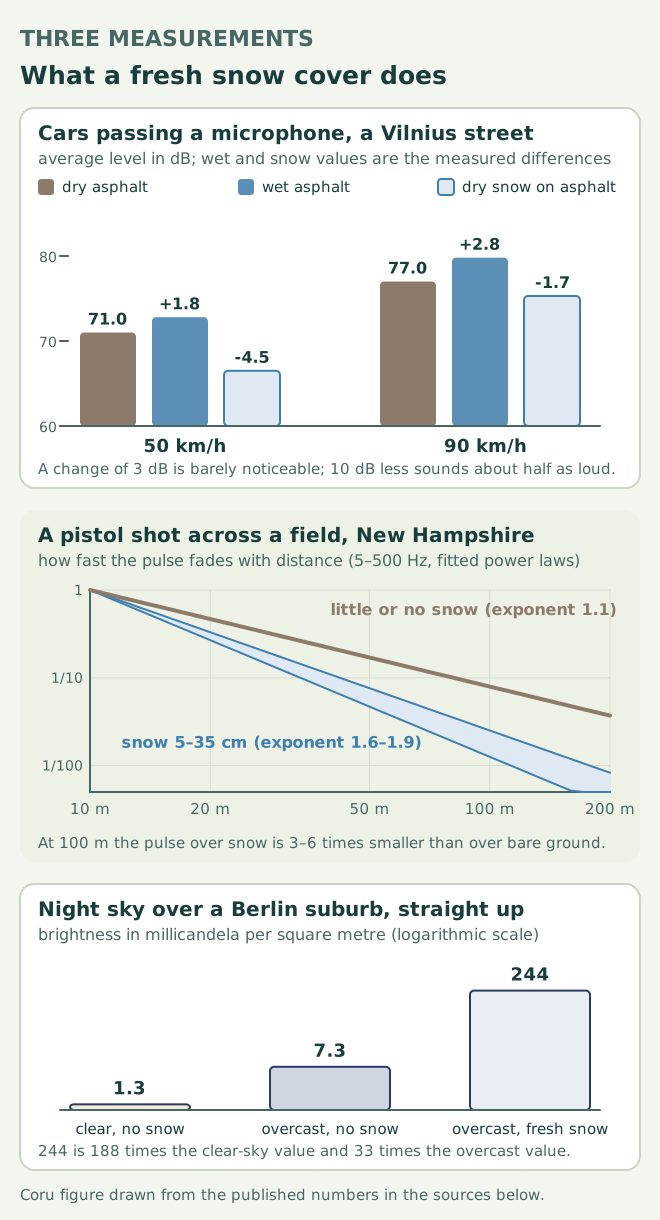
The cleanest modern numbers come from Donald Albert of the US Army Cold Regions Research and Engineering Laboratory in New Hampshire, who spent the winter of 1989–90 firing blank pistol shots across a field into an 80-metre line of microphones and geophones, on ten days across the season, with snow from 5 to 35 centimetres deep and densities from 100 to 350 kilograms per cubic metre. The two loudest recordings were made on the days with little or no snow, and were “about five times larger” than the pulses recorded over snow. Fitting the fade with distance to a power law, he found that over snow the amplitude fell as the distance to the power 1.6 to 1.9, against the 1.0 expected from pure spherical spreading and the 1.05 to 1.12 measured on the two days with little or no snow. Run the arithmetic and a pulse that has travelled a hundred metres over snow is three to six times smaller than the same pulse over bare ground. The waveforms over snow were also stretched out and dominated by low frequencies, exactly the treble-cut that Watson’s curve predicts.
Albert’s explanation is simple and physical. A sound wave passing over snow pushes air into the pores and pulls it out again, and that costs it energy: the pulses are “profoundly changed by the air forced into the snow pores as the pulses move over the surface”, which “greatly reduces the pulse amplitude and elongates the waveform compared to propagation above other ground surfaces”. The quantity that captures this is flow resistivity, how hard it is to push air through the ground. For grassland the pulses were matched with a value of 200 kilonewton-seconds per metre to the fourth; for snow, a tenth of that, 20. Grass is already an acoustically soft ground, as the standard tutorials say. Fresh snow is ten times softer.
This is also why the crust matters. The snow centre’s own wording is the one most explainers copy: “Fresh snow cover dampens sound because it absorbs sound waves. If the snow melts, however, and then refreezes, the newly formed ice layer reflects sound waves, allowing sound to travel far and clear.” Takada’s frozen field measured that sentence seventy years ago.
The cars go quiet too
Half of the hush never had anything to do with absorption. The loudest thing in most streets is traffic, and traffic on snow is quieter at the source and there is less of it.
In 2023 a team from Vilnius Gediminas Technical University, with a Czech co-author, published pass-by measurements of real traffic at one street site in Vilnius, with the same microphone set-up on dry asphalt, wet asphalt and asphalt covered with dry snow. Passenger cars at 50 kilometres per hour averaged 71 decibels on dry asphalt. On wet asphalt they were 1.8 decibels louder; on dry snow-covered asphalt 4.5 decibels quieter; on snow with ruts worn into it, back to within 0.1 decibel of the dry value. At 90 kilometres per hour, where tyre noise is louder to begin with, the car averaged 77 decibels, 2.8 decibels more when wet and 1.7 less on snow. The snow samples were not tiny: 58 cars on dry snow and 28 on rutted snow, against 24 on wet asphalt. The figure above shows these numbers. An earlier Lithuanian study noticed something related, though its speed intervals differ: in winter, speeding up from 40 to 50 kilometres per hour added only 2 decibels of noise, where in summer going from 50 to 70 added 5, which the authors put down to “the presence of ice and snow on the road”.
To read those decibels, use the rules of thumb from the US Federal Highway Administration’s noise guide: a change of 3 decibels is barely perceptible, 5 is readily perceptible, and a drop of 10 decibels sounds about half as loud. So a single car on fresh snow at town speed, 4.5 decibels down, is clearly quieter to the ear but nowhere near half as loud. What turns a clearly quieter car into a quiet street is that there are fewer cars and they drive more slowly. The same agency’s summary of road-weather studies gives average speed reductions of 30 to 40 per cent on signalised arterial roads with snowy or slushy pavement and traffic volumes down by 15 to 30 per cent; on freeways in heavy snow, average speeds can fall by 5 to 40 per cent. Slower tyres on softer snow, and fewer of them: every term in the sum shrinks.
For scale, the World Health Organization’s 2018 guideline for Europe recommends keeping road-traffic noise at night below 45 decibels, averaged over the night, and a normal conversation runs at 60 to 70.
The night turns bright
There is a twin to the hush that fewer people connect with it. Snow reflects 80 to 90 per cent of the sunlight that hits it, against 10 to 30 per cent for trees, plants and soil. At night that reflectivity works on street light. Andreas Jechow and Franz Hölker of the Leibniz Institute of Freshwater Ecology and Inland Fisheries in Berlin photographed the whole sky with a calibrated camera from Ludwigsfelde, a town near Berlin, on three winter nights with different cloud and snow cover, and published the result in 2019 under a name they coined for it: snowglow. Straight overhead, a clear night without snow measured 1.3 millicandela per square metre. An overcast night without snow was 7.3, five and a half times brighter, because clouds bounce the city’s light back down. An overcast night just after a heavy snowfall was 244: 188 times the clear-sky value and 33 times the overcast one. The light falling on the ground, 0.79 lux, was more than twice the brightest a full moon can ever manage, 0.32 lux at the zenith, which is only possible at the equator; a typical full moon at Berlin’s latitude gives 0.1 to 0.2 lux.
A separate Berlin study by Christopher Kyba and colleagues had already measured clouds alone amplifying the sky by a factor of 10.1 inside the city and 2.8 at 32 kilometres out. Add fresh snow under the clouds and a quiet suburban night becomes brighter than any moonlit one. The two effects are not causally linked: nothing about the brightness makes the street quieter. But they arrive together, on the same first night, from the same layer of trapped air and ice crystals, and that combination of hush and glow is probably what people are remembering when they say a snowy night feels unreal. The authors themselves list what their dataset lacks, a clear night with snow at the German site among other things, so the 33 and the 188 are one site on three nights, not a universal law.
What the hush is not
Three things get said about snowy silence that no measurement in our sources supports, and one that they contradict.
The first is that the falling flakes themselves muffle sound in the air. No saved study measured anything of the kind. The nearest evidence is one line in Takada’s 1954 paper: on a schoolyard, within a hundred metres, sound faded faster while snow was falling than on the same soft snow without flakes in the air, and also during a heat shimmer; the authors offered no mechanism and the effect is tangled up with the fresh surface. What falling snow does do is arrive quietly. Rain hits the pavement at speed and you hear impact noise; snowflakes, as a University of Kentucky news piece on the acoustician David Herrin’s work puts it, “barely make a sound”, because, in Herrin’s words, “with snow, the impact force is much less partly due to the reduced speed”.
The second is the striking fact that snowflakes are loud underwater. That one is real but irrelevant to the street. In 1999 Lawrence Crum and colleagues argued that a snowflake landing on water drags a tiny bubble under with it, and the bubble rings; the pitch is “rarely lower than 50 kHz”, far above hearing, and “one does not hear the ‘plunk’”. The much-quoted figure that falling snow adds 30 decibels to underwater noise comes from Crum’s remark in a 2000 press release about recordings in a motel swimming pool, not from a published measurement, and it concerns porpoises and other aquatic animals, not pedestrians.
The third is a precise-sounding absorption number. Herrin has said in interviews that “a couple inches of snow is roughly around 0.6 or 60 percent absorbing on average” in the audible range, and elsewhere “in between 0.5 to 0.9”; a consultancy blog cites an English reverberation-chamber test from the late 1930s that worked out to a noise reduction coefficient of 0.89 for a four-inch layer, with the original authors’ warning that the results “can only be approximate”. These are reasonable round figures, and Ishida’s 0.6 to 0.8 for ten centimetres of compact snow sits inside the range. But the single number hides the thing that matters most, the frequency: thin porous layers absorb treble and let bass through, which is why a snowy street loses its hiss and keeps its rumble.
The claim the sources contradict is the one about cold air. A science-centre blog explains that cold air is denser, so sound travels more slowly, so everything is quieter. Sound does travel more slowly in cold air, but slower is not quieter; a wave that arrives a few milliseconds later arrives with the same energy. What cold weather really does to outdoor sound is the opposite of a hush. On a clear, calm winter night the ground radiates its heat away and the air near it becomes colder than the air above, a temperature inversion, which the Hong Kong Observatory’s explainer describes with a line of Tang poetry about a temple bell heard across the water: “Since sound wave travels faster in warm air, an inversion layer will bend the propagation of outgoing sound towards the cool air, reaching farther locations.” Every outdoor-acoustics tutorial lists it: upward refraction in a temperature lapse, downward in an inversion. So the cold night after the storm has two forces pulling against each other, a surface that swallows sound and a sky that bends distant sound back down. Which one you notice depends on where you stand; none of our sources measured the two together.
Listen for yourself
The measurements suggest a small listening experiment that costs nothing and takes three mornings. Keep it to listening and looking: there is nothing to test by standing in a road.
- On the first morning after a snowfall, before the ploughs and the thaw, stand at the same window or doorstep you use every day and count how many seconds you can follow a passing car before it fades into the background. Note what is missing from the sound: the hiss and rustle go first, the low rumble stays.
- Do the same on a morning when the snow has been driven over, packed and refrozen. The measurements predict the second morning will sound much like a snowless one; Takada’s frozen field and the rutted-snow cars both point that way.
- If a clear, windless night follows, listen late in the evening for sounds that are normally too far away to hear, a railway, a road on the other side of the valley. If they are suddenly there, you are hearing the inversion, not the snow.
- On an overcast night with fresh snow, look at the sky from the same spot as on an ordinary overcast night. The Berlin measurement suggests a difference you will not need a camera to see.
What the measurements leave open
Albert’s pistol-shot numbers cover 5 to 500 hertz, the low end of hearing, so the three-to-sixfold fade is a floor rather than a description of the whole audible range; Takada’s audible-band curves are in the 1954 paper, but this article uses only the authors’ stated results, not readings off the curves. Watson’s absorption curve was calculated, not measured, and most of the later laboratory work measured what happens inside snow rather than along it. The road measurements come from one site in one city. The snowglow factors come from one suburb on three nights, with the clear-sky-with-snow case missing. And no study in our sources has measured a snowy street and a temperature inversion on the same night, which is the experiment that would finally say how much of the hush is the snow and how much is the weather that brought it.
Sources & further reading
- Ishida T. Acoustic Properties of Snow. Contributions from the Institute of Low Temperature Science, Hokkaido University, Series A, 1965, 20:23–63
- Lang T. E. Measurements of acoustic properties of hard-pack snow. Journal of Glaciology, 1976, 17(76):269–276
- Johnson J. B. Audibility within and outside deposited snow. Journal of Glaciology, 1985, 31(108):136–142
- Watson R. B. On the Propagation of Sound over Snow. The Journal of the Acoustical Society of America, 1948, 20(6):846–848
- Takada M., Ohkhochi S., Nasu N. On the Absorption Coefficient of Snow and the Propagation of Sound along Snow Surface. Journal of the Acoustical Society of Japan, 1954, 10(1):23–27
- Albert D. G. Preliminary analysis of measured sound propagation over various seasonal snow covers. Fourth International Symposium on Long-Range Sound Propagation, NASA CP-3101, 1990
- Albert D. G., Orcutt J. A. Acoustic pulse propagation above grassland and snow: comparison of theoretical and experimental waveforms. The Journal of the Acoustical Society of America, 1990, 87(1):93–100
- Albert D. G. Acoustic waveform inversion with application to seasonal snow covers. The Journal of the Acoustical Society of America, 2001, 109(1):91–101
- Daigle G. A. Outdoor sound propagation. Canadian Acoustics, 2004, 32(3):12
- Embleton T. F. W. Tutorial on sound propagation outdoors. The Journal of the Acoustical Society of America, 1996, 100(1):31–48
- National Snow and Ice Data Center. Quick facts about snow
- National Snow and Ice Data Center. Why snow matters
- Danilevičius A., Karpenko M., Křivánek V. Research on the noise pollution from different vehicle categories in the urban area. Transport, 2023, 38(1):1–11
- Leipus L., Butkus D., Januševičius T. Research on motor transport produced noise on gravel and asphalt roads. The Baltic Journal of Road and Bridge Engineering, 2010, 5(3):125–131
- US Federal Highway Administration, Road Weather Management Program. How do weather events affect roads?
- US Federal Highway Administration. Highway Traffic Noise: Analysis and Abatement Guidance. Noise fundamentals
- World Health Organization Regional Office for Europe. Environmental Noise Guidelines for the European Region, 2018
- National Institute on Deafness and Other Communication Disorders. Noise-Induced Hearing Loss
- Jechow A., Hölker F. Snowglow — The Amplification of Skyglow by Snow and Clouds Can Exceed Full Moon Illuminance in Suburban Areas. Journal of Imaging, 2019, 5(8):69
- Kyba C. C. M., Ruhtz T., Fischer J., Hölker F. Cloud Coverage Acts as an Amplifier for Ecological Light Pollution in Urban Ecosystems. PLoS ONE, 2011, 6(3):e17307
- Crum L. A., Pumphrey H. C., Roy R. A., Prosperetti A. The underwater sounds produced by impacting snowflakes. The Journal of the Acoustical Society of America, 1999, 106(4):1765–1770
- ScienceDaily, 6 March 2000 (Johns Hopkins University): Falling Snow Can Create A Noisy Nuisance ... Underwater
- University of Kentucky news, 21 January 2016: The Science Behind Snow's Serenity
- AccuWeather: Why does it become so quiet after a fresh snowfall? (archived copy)
- Acentech blog, 18 December 2019: The Quiet Snow: Does Snow Reduce Noise?
- Montreal Science Centre blog: Why does everything get so quiet after a snow fall?
- Hong Kong Observatory, Cheung Man-sze, January 2019: Inversion layer — impose its own bounds