Find everything we’ve left on the Moon
From Luna 2 in 1959 to a Falcon 9 stage in 2026: everything we have left on the Moon on one map. Turn it and find Apollo 11’s descent stage, Lunokhod 1 and the Japanese lander that touched down on its nose.
Every object on the Moon
Turn the Moon and tap a dot: the page shows what the object is, whose it is, when and how it got to the Moon. Without scripts, a table of all 105 objects follows below.
Drag the Moon to turn it, and tap a dot.
- landed
- crashed
- crashed on purpose or after its mission
Everything we have left on the Moon, by Wikipedia’s list
English Wikipedia’s “List of artificial objects on the Moon”, revision of 20 August 2026 (CC BY-SA 4.0). The near side is longitude 90° W to 90° E. Masses are as listed: some are unknown, and objects lying together sometimes share one figure. The Moon map is NASA’s Scientific Visualization Studio CGI Moon Kit, from LROC camera images.
| Object | Country | Year | Mass, kg | How it got there | Where |
|---|---|---|---|---|---|
| Luna 2 | USSR | 1959 | 390 | on purpose or after its mission | 29.1° N, 0.0° E (near side) |
| Luna 2: third stage of its rocket | USSR | 1959 | 9,100 | on purpose or after its mission | 29.1° N, 0.0° E (near side) |
| Ranger 4 | United States | 1962 | 331 | crashed | 15.5° S, 130.7° W (far side) |
| Ranger 6 | United States | 1964 | 381 | on purpose or after its mission | 9.4° N, 21.5° E (near side) |
| Ranger 7 | United States | 1964 | 365 | on purpose or after its mission | 10.6° S, 20.6° W (near side) |
| Luna 5 | USSR | 1965 | 1,474 | crashed | 8.0° N, 23.0° W (near side) |
| Luna 7 | USSR | 1965 | 1,504 | crashed | 9.8° N, 47.8° W (near side) |
| Luna 8 | USSR | 1965 | 1,552 | crashed | 9.1° N, 63.3° W (near side) |
| Ranger 8 | United States | 1965 | 367 | on purpose or after its mission | 2.6° N, 24.8° E (near side) |
| Ranger 9 | United States | 1965 | 367 | on purpose or after its mission | 12.8° S, 2.4° W (near side) |
| Luna 9: descent stage | USSR | 1966 | 1,538 | on purpose or after its mission | 7.1° N, 64.4° W (near side) |
| Luna 9: the lander capsule | USSR | 1966 | 99 | landed | 7.1° N, 64.4° W (near side) |
| Luna 10 | USSR | 1966 | 1,600 | on purpose or after its mission | unknown |
| Luna 11 | USSR | 1966 | 1,640 | on purpose or after its mission | unknown |
| Luna 12 | USSR | 1966 | 1,670 | on purpose or after its mission | unknown |
| Surveyor 1 | United States | 1966 | 270 | landed | 2.5° S, 43.3° W (near side) |
| Luna 13 | USSR | 1966 | 113 | landed | 18.9° N, 62.0° W (near side) |
| Lunar Orbiter 1 | United States | 1966 | 386 | on purpose or after its mission | 6.7° N, 162.0° E (far side) |
| Surveyor 2 | United States | 1966 | 292 | crashed | 5.5° N, 12.0° W (near side) |
| Lunar Orbiter 2 | United States | 1966 | 385 | on purpose or after its mission | 3.0° N, 119.0° E (far side) |
| Lunar Orbiter 3 | United States | 1966 | 386 | on purpose or after its mission | 14.3° N, 97.7° W (far side) |
| Surveyor 3 | United States | 1967 | 281 | landed | 3.0° S, 23.4° W (near side) |
| Lunar Orbiter 4 | United States | 1967 | 386 | on purpose or after its mission | unknown |
| Surveyor 4 | United States | 1967 | 283 | crashed | 0.4° N, 1.3° W (near side) |
| Explorer 35 | United States | 1967 | 104 | on purpose or after its mission | unknown |
| Lunar Orbiter 5 | United States | 1967 | 386 | on purpose or after its mission | 3.0° S, 83.0° W (near side) |
| Surveyor 5 | United States | 1967 | 281 | landed | 1.5° N, 23.2° E (near side) |
| Surveyor 6 | United States | 1967 | 282 | landed | 0.5° N, 1.4° W (near side) |
| Surveyor 7 | United States | 1968 | 290 | landed | 41.0° S, 11.5° W (near side) |
| Luna 14 | USSR | 1968 | 1,670 | on purpose or after its mission | unknown |
| Apollo 10: Snoopy’s descent stage | United States | 1969 | 2,211 | on purpose or after its mission | unknown |
| Apollo 11: Eagle’s descent stage | United States | 1969 | 2,034 | landed | 0.7° N, 23.5° E (near side) |
| Luna 15 | USSR | 1969 | 2,718 | crashed | unknown |
| Apollo 11: Eagle’s ascent stage | United States | 1969 | 2,184 | on purpose or after its mission | unknown |
| Apollo 12: Intrepid’s descent stage | United States | 1969 | 2,211 | landed | 3.0° S, 23.4° W (near side) |
| Apollo 12: Intrepid’s ascent stage | United States | 1969 | 2,164 | on purpose or after its mission | 3.9° S, 21.2° W (near side) |
| Luna 16: descent stage | USSR | 1970 | 1,380 | landed | 0.7° S, 56.3° E (near side) |
| Luna 17 and Lunokhod 1 | USSR | 1970 | 5,600 | landed | 38.3° N, 35.0° W (near side) |
| Apollo 13: S-IVB third stage | United States | 1970 | 13,454 | on purpose or after its mission | 2.8° S, 27.9° W (near side) |
| Luna 18 | USSR | 1971 | 1,880 | crashed | 3.6° N, 56.5° E (near side) |
| Luna 19 | USSR | 1971 | 1,880 | on purpose or after its mission | unknown |
| Apollo 14: S-IVB third stage | United States | 1971 | 14,016 | on purpose or after its mission | 8.1° S, 26.0° W (near side) |
| Apollo 14: Antares’s descent stage | United States | 1971 | 2,144 | landed | 3.6° S, 17.5° W (near side) |
| Apollo 14: Antares’s ascent stage | United States | 1971 | 2,132 | on purpose or after its mission | 3.4° S, 19.7° W (near side) |
| Apollo 15: S-IVB third stage | United States | 1971 | 14,036 | on purpose or after its mission | 1.5° S, 11.8° W (near side) |
| Apollo 15: Falcon’s descent stage | United States | 1971 | 2,809 | landed | 26.1° N, 3.6° E (near side) |
| Apollo 15: Lunar Roving Vehicle | United States | 1971 | 210 | landed | 26.1° N, 3.7° E (near side) |
| Apollo 15: Falcon’s ascent stage | United States | 1971 | 2,132 | on purpose or after its mission | 26.4° N, 0.2° E (near side) |
| Apollo 15: subsatellite | United States | 1971 | 36 | on purpose or after its mission | unknown |
| Luna 20: descent stage | USSR | 1972 | — | landed | 3.6° N, 56.5° E (near side) |
| Apollo 16: S-IVB third stage | United States | 1972 | 14,002 | on purpose or after its mission | 1.9° N, 24.6° W (near side) |
| Apollo 16: Orion’s descent stage | United States | 1972 | 2,765 | landed | 9.0° S, 15.5° E (near side) |
| Apollo 16: Lunar Roving Vehicle | United States | 1972 | 210 | landed | 9.0° S, 15.5° E (near side) |
| Apollo 16: Orion’s ascent stage | United States | 1972 | 2,138 | on purpose or after its mission | unknown |
| Apollo 16: subsatellite | United States | 1972 | 36 | on purpose or after its mission | unknown |
| Apollo 17: S-IVB third stage | United States | 1972 | 13,960 | on purpose or after its mission | 4.2° S, 12.3° W (near side) |
| Apollo 17: Challenger’s descent stage | United States | 1972 | 2,798 | landed | 20.2° N, 30.8° E (near side) |
| Apollo 17: Lunar Roving Vehicle | United States | 1972 | 210 | landed | 20.2° N, 30.8° E (near side) |
| Apollo 17: Challenger’s ascent stage | United States | 1972 | 2,150 | on purpose or after its mission | 20.0° N, 30.5° E (near side) |
| 96 bags of the astronauts’ waste | United States | 1969–1972 | — | left | unknown |
| Luna 21 and Lunokhod 2 | USSR | 1973 | 4,850 | landed | 25.9° N, 30.4° E (near side) |
| Explorer 49 | United States | 1973 | 328 | on purpose or after its mission | unknown |
| Luna 22 | USSR | 1974 | 4,000 | on purpose or after its mission | unknown |
| Luna 23 | USSR | 1974 | 5,600 | landed | 12.8° N, 62.2° E (near side) |
| Luna 24: descent stage | USSR | 1976 | — | landed | 12.8° N, 62.2° E (near side) |
| Hagoromo, Hiten’s small orbiter | Japan | 1990 | 12 | on purpose or after its mission | unknown |
| Hiten | Japan | 1993 | 143 | on purpose or after its mission | 34.3° S, 55.6° E (near side) |
| Lunar Prospector | United States | 1998 | 126 | on purpose or after its mission | 87.7° S, 42.4° E (near side) |
| SMART-1 | European Space Agency | 2006 | 307 | on purpose or after its mission | 34.3° S, 46.2° W (near side) |
| Chandrayaan-1: Moon Impact Probe | India | 2008 | 35 | on purpose or after its mission | 89.8° S, 39.4° W (near side) |
| Okina, Kaguya’s relay satellite | Japan | 2009 | 53 | on purpose or after its mission | 28.2° N, 159.0° W (far side) |
| Ouna, Kaguya’s small satellite | Japan | unknown | 53 | on purpose or after its mission | unknown |
| Chang’e 1 | China | 2009 | 2,000 | on purpose or after its mission | 1.5° S, 52.4° E (near side) |
| Kaguya | Japan | 2009 | 1,984 | on purpose or after its mission | 65.5° S, 80.5° E (near side) |
| LCROSS shepherding spacecraft | United States | 2009 | 700 | on purpose or after its mission | 84.7° S, 49.4° W (near side) |
| LCROSS Centaur stage | United States | 2009 | 2,270 | on purpose or after its mission | 84.7° S, 48.7° W (near side) |
| GRAIL | United States | 2012 | 133 | on purpose or after its mission | 75.6° N, 26.6° W (near side) |
| Chang’e 3 lander | China | 2013 | 1,200 | landed | 44.1° N, 19.5° W (near side) |
| Chang’e 3: Yutu rover | China | 2013 | 1,200 | landed | 44.1° N, 19.5° W (near side) |
| LADEE | United States | 2014 | 248 | on purpose or after its mission | 10.8° N, 91.6° W (far side) |
| Chang’e 4 lander | China | 2019 | 1,200 | landed | 45.5° S, 177.6° E (far side) |
| Chang’e 4: Yutu-2 rover | China | 2019 | 1,200 | landed | 45.5° S, 177.6° E (far side) |
| Beresheet | Israel | 2019 | 150 | crashed | 32.6° N, 19.4° E (near side) |
| Longjiang-2 | China | 2019 | 47 | on purpose or after its mission | 16.7° N, 159.5° E (far side) |
| Chandrayaan-2: Vikram and Pragyan | India | 2019 | 1,471 | crashed | 70.9° S, 22.8° E (near side) |
| Chang’e 5 descent stage | China | 2020 | 3,200 | landed | 43.1° N, 51.9° W (near side) |
| Chang’e 5 ascent stage | China | 2020 | 700 | on purpose or after its mission | 30.0° S, 0.0° E (near side) |
| Chang’e 5-T1: rocket third stage | China | 2022 | 2,800 | on purpose or after its mission | 5.2° N, 125.5° W (far side) |
| Manfred Memorial Moon Mission | Luxembourg | 2022 | — | on purpose or after its mission | 5.2° N, 125.5° W (far side) |
| Hakuto-R Mission 1 | Japan | 2023 | 340 | crashed | 47.6° N, 44.1° E (near side) |
| Emirates Lunar Mission | United Arab Emirates | 2023 | — | crashed | 47.6° N, 44.1° E (near side) |
| Luna 25 | Russia | 2023 | 1,750 | crashed | 57.9° S, 61.4° E (near side) |
| Chandrayaan-3: Vikram and Pragyan | India | 2023 | 1,752 | landed | 69.4° S, 32.3° E (near side) |
| SLIM | Japan | 2024 | 119 | landed | 13.3° S, 25.2° E (near side) |
| LEV-1 | Japan | 2024 | 2.1 | landed | 13.3° S, 25.2° E (near side) |
| LEV-2 | Japan | 2024 | 0.25 | landed | 13.3° S, 25.2° E (near side) |
| IM-1 Odysseus | United States | 2024 | 1,903 | landed | 84.9° S, 12.9° E (near side) |
| Chang’e 6 descent stage | China | 2024 | 3,200 | landed | 41.6° S, 154.0° W (far side) |
| Chang’e 6: Jinchan rover | China | 2024 | — | landed | 41.6° S, 154.0° W (far side) |
| Chang’e 6 ascent stage | China | 2024 | 700 | on purpose or after its mission | 39.0° S, 180.0° E (far side) |
| Blue Ghost Mission 1 | United States | 2025 | 469 | landed | 18.6° N, 61.8° E (near side) |
| Hakuto-R Mission 2: Resilience | Japan | 2025 | 340 | crashed | 60.4° N, 4.6° W (near side) |
| Tenacious rover | Luxembourg | 2025 | — | crashed | 60.4° N, 4.6° W (near side) |
| IM-2 Athena and its rovers | United States | 2025 | 1,919 | landed | 84.8° S, 29.2° E (near side) |
| Falcon 9 upper stage | United States | 2026 | 3,900 | on purpose or after its mission | 19.5° N, 93.3° W (far side) |
Where the dots come from
English Wikipedia keeps a list of everything people have sent to the Moon that is still there: probes, descent stages, rovers, rocket stages. Its revision of 20 August 2026 has 105 rows. The place of 87 objects is known, and those are the dots on the map. Another 18 came down nobody knows where, among them Luna 10, Luna 11 and Luna 12, which fell after their missions ended, and Apollo 11’s ascent stage.
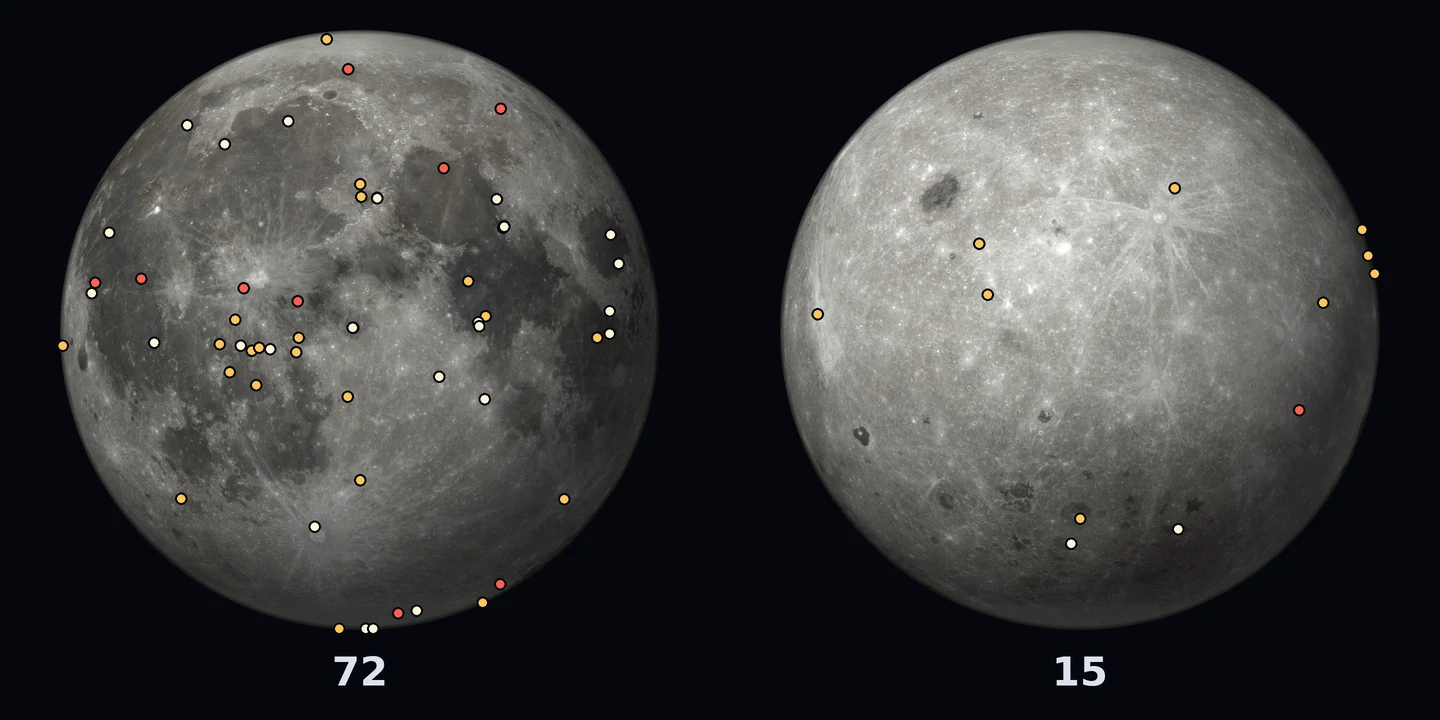
A dot’s colour tells how the object got there. White landed. Red crashed when it was not meant to. Yellow was crashed on purpose, like the impact probes and rocket stages, or came down after its mission, like the Moon’s orbiters. Of the 87 dots, 36 are white, 14 red and 37 yellow.
Why nearly everything is on one side
The Moon always turns the same face to the Earth, and that side holds 72 of the 87 dots. The far side has 15, and only China has made a soft landing there. Chang’e 4 became the first spacecraft to land on the far side on 3 January 2019, and Chang’e 6 brought back the first samples from it in 2024.
There is no direct line to the Earth from the far side: for Chang’e 4, China launched the Queqiao relay satellite a year earlier, in 2018. Press Far side. Of its 15 dots, 10 are yellow: orbiters brought down after their missions and rocket stages. The only white ones are four Chinese: two landers and two rovers.
What weighs the most
The list itself puts everything we have left on the Moon at over 187 tonnes; adding up the masses in its rows gives about 194. The heaviest objects are the five S-IVB third stages of the Saturn V rockets of Apollo 13 to 17, about 14 tonnes each, 69.5 tonnes together, more than a third of the whole. They were crashed into the Moon on purpose so that the seismic waves of the impacts would reveal its interior.
The seismometers were left there by the astronauts themselves. When Apollo 12’s ascent stage was dropped onto the Moon, the Moon kept shaking for over 55 minutes, which surprised the scientists.
How the Moon filled up
Press From 1959 and the Moon fills up year by year. The first dot is Luna 2: on 13 September 1959 the Soviet probe became the first human-made object to touch another world. Then came the race: by the end of 1969 there are 27 dots on the map, by the end of 1976, 49. The last of that era was Luna 24, the last lunar spacecraft the Soviet Union launched. The next object in the list arrived only in 1990.
Since 2019, 13 spacecraft have tried to land on the Moon. Five crashed, two landed and tipped over, and Japan’s SLIM came down on its nose. The South pole button shows where landers aim now: Chandrayaan-3 and both Intuitive Machines landers set down there, and Chandrayaan-2 and Luna 25 crashed nearby.
Where the data comes from
The dots follow English Wikipedia’s “List of artificial objects on the Moon”, revision of 20 August 2026, under CC BY-SA 4.0. We take facts only from it: the name, the country, the year, the mass, the fate and the coordinates. The list is incomplete: some masses are unknown, and some objects lying together share one figure.
The Moon map is the CGI Moon Kit of NASA’s Scientific Visualization Studio, made from the LROC camera images of the Lunar Reconnaissance Orbiter. The short stories on the object cards come from Wikipedia’s articles about them, linked below.
The film
Explore the same subject in our Coru Short, “190 Tonnes on the Moon: Everything We've Left There”. Watch it on YouTube using the link below.
Sources & further reading
- Wikipedia: List of artificial objects on the Moon (revision of 20 August 2026)
- NASA Scientific Visualization Studio: CGI Moon Kit
- Wikipedia: Luna 2
- Wikipedia: Luna 24
- Wikipedia: Apollo 11
- Wikipedia: Apollo 12
- Wikipedia: Apollo 12 Passive Seismic Experiment
- Wikipedia: S-IVB
- Wikipedia: Lunokhod 1
- Wikipedia: Far side of the Moon
- Wikipedia: Tidal locking
- Wikipedia: Chang'e 4
- Wikipedia: Chang'e 6
- Wikipedia: Beresheet
- Wikipedia: Chandrayaan-2
- Wikipedia: Luna 25
- Wikipedia: Smart Lander for Investigating Moon
- Wikipedia: IM-1
- Wikipedia: IM-2
- Coru Short «190 Tonnes on the Moon: Everything We've Left There» (YouTube)