Why does the Moon change shape? Try a lamp-and-ball model
The Moon stays round. What changes is how much of its sunlit half faces us. A fixed lamp and a ball let you test that idea in three positions.
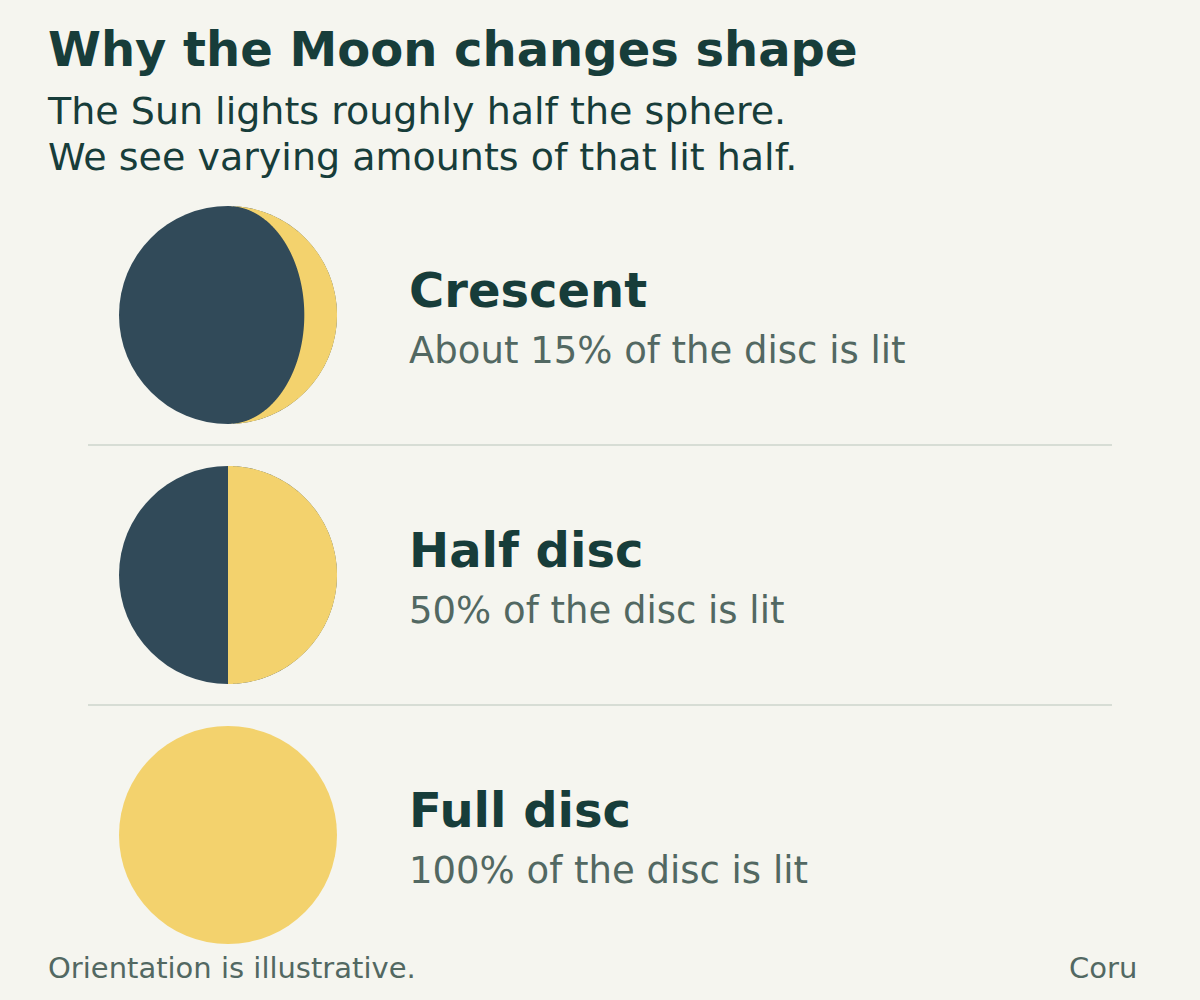
One half of a sphere, a changing part of a disk
Outside an eclipse, the Sun lights approximately half of the Moon. As the Moon travels around Earth, we see that lit half from different angles. A crescent, a half-lit disk and a full disk are views of the same spherical Moon.
“50% illuminated” describes half of the disk we see, not half of the whole Moon suddenly receiving sunlight. At full Moon, the far side is still mostly in night.
Set up a small model
Use one fixed lamp, an opaque, pale, matte ball and a room with dimmer background light. A translucent ball can glow through; a glossy one can add distracting reflections. Keep the lamp farther from you than the ball is. Leave space to turn without moving the lamp.
Your viewing position represents an observer on Earth, the ball represents the Moon, and the lamp represents the Sun. Hold the ball at arm’s length and follow it with your gaze as you slowly turn your upper body. Keep your hand under the ball. Use a stable, ordinary lamp at a comfortable distance; do not look into the bulb or touch a hot light source.
Try three views
Keep the lamp fixed throughout. You are changing the ball’s position around you, not dimming the light. These positions are approximate; the nearby lamp is not an exact scale model of the distant Sun.
- Lamp to one side: hold the ball in front of you with the lamp roughly to your left or right. Adjust your direction a little until about half of the visible disk is bright. Sketch the boundary.
- Lamp behind you: turn so the lamp is behind your shoulder. Raise the ball enough to clear your head’s shadow. Most or almost all of its visible disk should now be bright. If a dark patch crosses it, move it out of your shadow.
- Lamp obliquely ahead: turn toward the lamp’s side of the room, keeping the ball and your gaze comfortably away from the bulb. Look for a crescent. As the ball’s direction gets closer to the lamp’s direction, less of its sunlit side faces you. Stop if the light is uncomfortable.
If the result looks wrong
A dark patch at the “full” position is a useful clue: something may be blocking the light. Move the ball slightly up or sideways. If the patch disappears, you have separated a cast shadow from the ordinary phase effect.
- Every view looks bright: reduce other room lights or try an opaque ball.
- The boundary looks fuzzy: check for several light sources or a large luminous panel. One compact source gives a clearer model.
- One small spot is dazzling: try a matte surface; a reflection is not the outline of the illuminated half.
- Nothing changes: check that you are turning the ball around your viewing position, rather than only spinning it in your hand.
Why this is not Earth’s shadow
Earth’s shadow can darken the Moon during a lunar eclipse. Ordinary phases come from viewing the sunlit half at different angles. The Moon’s orbit is tilted relative to Earth’s orbital plane, so it usually passes above or below Earth’s shadow near full Moon.
In the model, your head can block the lamp. That blockage demonstrates a different geometry; it is not needed to make a crescent. The model also compresses distances and time, and room light can brighten the unlit side. It explains the changing shape, not exact phase dates or the Moon’s orientation in your sky.
A quick check before you put the ball away
Suppose the lamp stays behind you and you spin the matte ball in place. Should a full-looking disk turn into a crescent?
No. With the ball’s position and lighting direction unchanged, its overall illuminated shape stays essentially the same; surface markings may move. To change the phase-like shape, change the relationship between the light, ball and viewpoint.
What “quarter Moon” means
First and last quarter both show about half of the disk lit. The names refer to stages in the cycle, not a quarter of the visible disk. A complete cycle averages about 29.5 days.
The diagram shows three example shapes, not an orientation rule or the whole sequence. Which side looks bright depends on the viewing orientation; do not use this drawing alone to label a real crescent as waxing or waning. For a next step outdoors, use the linked daytime-Moon guide below.