Paper bridge experiment: what do three folds change?
Same paper, three folds, one question: what changes? Make a prediction, test three fresh pairs and record how each bridge behaves.
Before you fold, make a prediction
Two identical paper strips cross a gap. One stays flat; one gets three folds. Which will sag more under the same load? Predict first—including what would change your mind.
Compare two shapes with a clear stopping rule. How a bridge gives way matters too. No result is supplied: observe your own paper and folds.
Prepare three fresh pairs
Gather three sheets of identical printer paper, scissors, a ruler, two stable book stacks of equal height (at least 4 cm), a timer, 20 identical small paperclips and one stiff card square, 4 × 4 cm. Keep small parts away from young children.
Cut six strips, each 20 × 10 cm. Cut each pair side by side from one sheet, with their long edges pointing the same way. Keep three strips flat and uncreased. Use a fresh pair for each round; folding a previously loaded strip would mix shape with damage.
Make folds that cross the gap
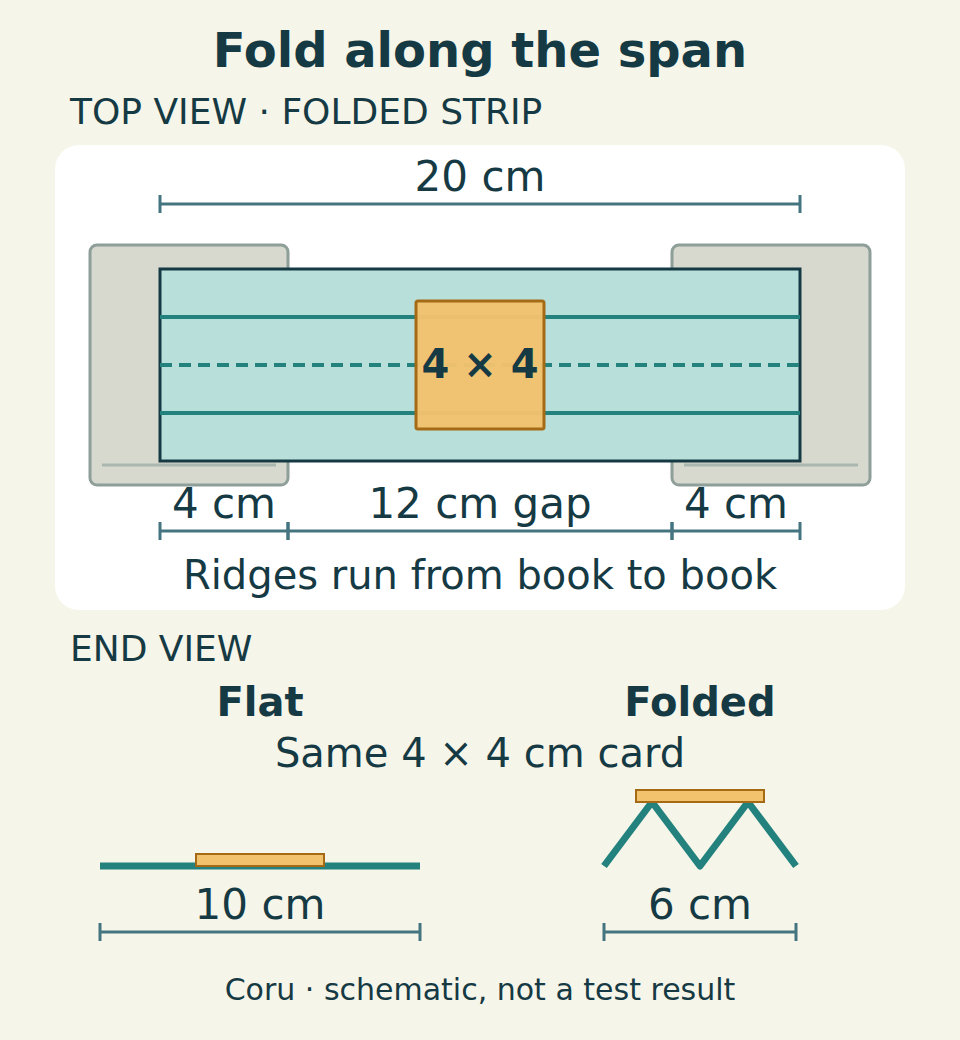
On each folded strip, mark lines 2.5, 5 and 7.5 cm from a long edge. All three lines run the full 20 cm length. Fold alternately up and down along them to make four equal panels. Open the accordion evenly to a total width of 6 cm, with both outside edges down and two ridges up.
The ridges must run from one book stack to the other, like rails across a river. Do not turn them sideways across the bridge. The folded strip is still 20 cm long; its narrower footprint is part of the shape change.
Set the inside edges of the stacks 12 cm apart. Centre each strip across that gap, leaving 4 cm on each support. Keep the gap and supports fixed. Do not tape, clamp or hold the paper.
Use the same load, in the same place
Centre the card square halfway across the gap and halfway across the paper. On the accordion it rests across both upper ridges. The card spreads the clips over a small area; it must not touch the books. Reuse this same card and the same clips for every test.
Mark the midpoint of the card edge facing you; keep this mark visible. For each strip, place the empty card and wait 10 seconds. If unstable, slipping, collapsed or touching the table, record 0 clips and the cause. Otherwise measure h0: the mark’s height above the tabletop, including existing stable sag. Read a vertical ruler beside it at eye level without touching the bridge.
Add one clip gently to the card’s centre. Keep the pile low. Wait 10 seconds, then measure the same mark. Repeat one clip at a time. Do not adjust the bridge during a run.
Stop before turning it into a contest
Stop if the mark drops at least 1 cm below h0, paper develops a new sharp kink or collapses, an end slips off, clips spill or paper, card or clips touch the tabletop. Stop at 20 clips too. These are activity limits, not engineering safety ratings.
Record the last count that passed the full 10 seconds and the stop reason: failure at clip n means n−1 passed. Write “at least 20” only after clip 20 passes 10 seconds; no maximum is established. Distinguish spills and slips from bending. Mark accidentally bumped runs invalid.
Test three fresh pairs, alternating which shape goes first. Never reuse damaged strips.
Copy this results sheet
text
Prediction: _________________________
Paper and clip type: _________________
Gap: 12 cm | strips: 20 × 10 cm

Round | Shape | h0 (cm) | Last count | Stop reason
1     | Flat  |         |            |
1     | Folded|         |            |
2     | Flat  |         |            |
2     | Folded|         |            |
3     | Flat  |         |            |
3     | Folded|         |            |

What repeated? _______________________
What differed between rounds? ________
Write “at least 20” only if all 20 pass 10 seconds; retain slips, spills and invalid runs.
What the folds change
Folding does not add paper. It gives the cross-section height: some paper now sits above and below the middle of the structure. During downward bending, upper regions tend to shorten and lower regions tend to stretch. Moving material farther from the neutral region can increase resistance to bending.
That explanation assumes the section keeps its shape. Paper folds can open, local panels can buckle, and the whole bridge can twist or slide. An open accordion is not a rigid triangular truss. Fold direction, workmanship and loading all matter.
What can you conclude?
Compare all three pairs and stop reasons. Results describe these strips, load and rule. They cannot prove every folded bridge is stronger or predict a full-size bridge.
Describe any variation. Next, change one planned feature—perhaps the gap—and repeat both shapes with fresh paper. Investigate unexpected results; keep the first records.