Why does crumpled paper fall faster than a flat sheet?
Crumpling a sheet changes how it moves through air, without adding paper. A compact ball usually falls faster than the same kind of sheet released flat, because air slows the two shapes differently.
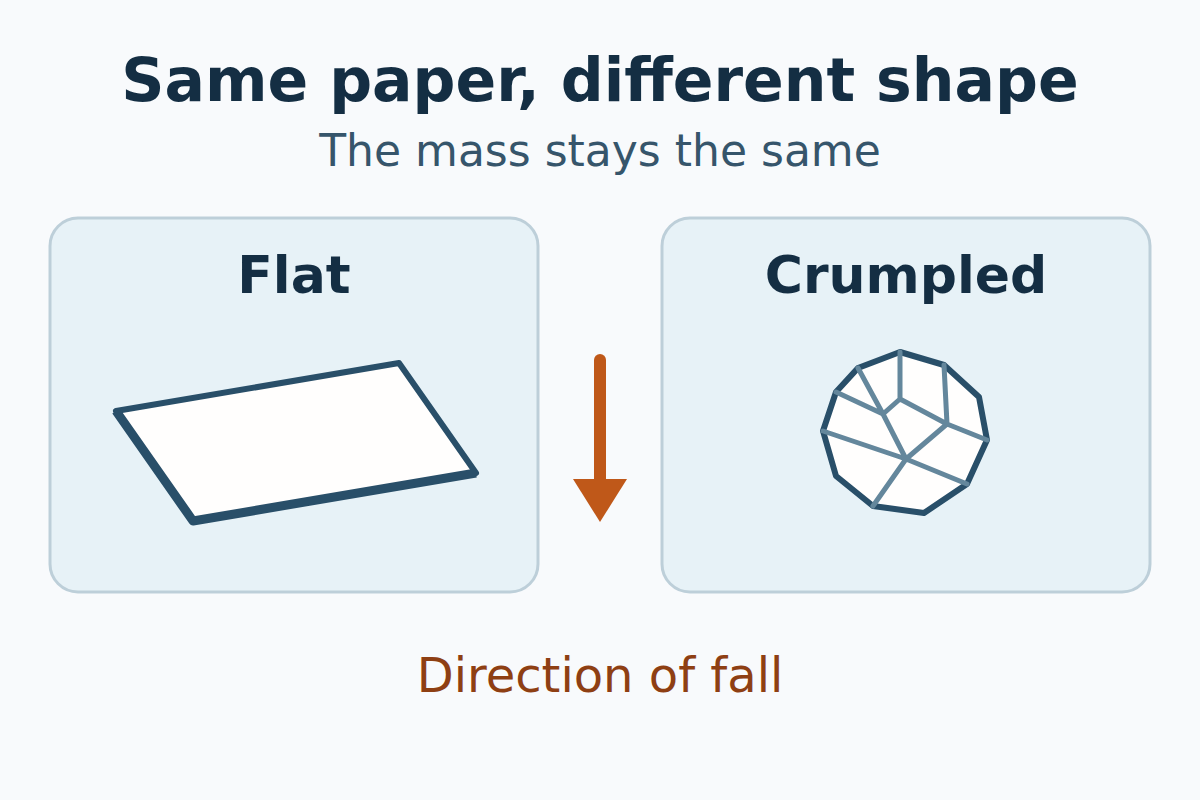
The key difference is shape, not extra weight
A falling sheet is pulled down by gravity and interacts with the air around it. Air resistance, or drag, opposes motion through the air. A broad sheet released horizontally usually flutters down; a tightly crumpled ball of matching paper usually reaches the floor sooner.
Crumpling does not add mass. It packs the paper into a smaller space and changes its shape and the area facing its direction of travel. The amount of paper stays the same. Here is a way to compare those effects without a stopwatch.
Set up a five-to-ten-minute comparison
- Use two dry sheets of ordinary printer paper from the same pack, with the same size and thickness. Keep both whole: no weights, tape or added objects.
- Choose an indoor space with still air and a clear, dry floor. Turn off a nearby fan and keep away from furniture. Stand on the floor; waist-to-chest height is enough.
- One person can release both sheets, one in each hand. A second person, if available, can watch which touches the floor first. Decide on your prediction before each comparison.
First compare flat with flat
Hold both sheets roughly horizontal, with their broad faces towards the floor. Support them lightly with your fingertips, with their lowest parts at the same height. Open both hands together without pushing either sheet. Keep them side by side with a gap so they do not touch or overlap.
Repeat three times, swapping the sheets between your left and right hands. Record which lands first, or write “unclear”. They may tilt, drift or flutter differently even though they match. This first comparison helps you notice uneven release or moving air; it does not guarantee an exact tie.
Now change one sheet into a ball
Keep one sheet flat. Crumple the other into a compact ball without tearing anything off or adding anything. Predict the landing order, then release the pair from the same height as before, with their lowest parts level. Start the flat sheet horizontally again.
Do three drops, swapping hands between drops. Write down both the landing order and anything you saw: a sideways drift, a spin or one hand releasing late. If a sheet hits furniture, mark that drop as interrupted and try again. Keep the note rather than treating it as an ordinary floor landing.
The ball will usually land first. If it does not, do not change your record to fit the prediction. Check the release, drafts and starting orientation; the next section explains why these can matter.
Copy this observation log
text
Prediction: _________________________________

Pair        Drop   First to reach floor   What happened?
flat/flat     1    ___________________   ______________
flat/flat     2    ___________________   ______________
flat/flat     3    ___________________   ______________
flat/ball     1    ___________________   ______________
flat/ball     2    ___________________   ______________
flat/ball     3    ___________________   ______________

What changed? _______________________________
What stayed the same? ________________________
Blank log, not measured results. “Unclear” and “interrupted” are useful observations. Short drop times are hard to judge precisely by hand.
Why the flat sheet is usually slowed more
Imagine looking at each shape from below while it moves downwards. The horizontal sheet presents a broad face; the compact ball presents a much smaller outline. The sheet has not lost paper area when crumpled: its area facing the airflow has changed.
At the same speed through the same air, a broad flat sheet facing the motion typically experiences more drag than the compact ball. Shape matters too, not just area. During a real drop the speeds, angles and air motion keep changing, so this is not a claim that one drag force is larger at every instant.
Gravity still acts on both. For matching sheets its downward pull is approximately the same. The different motion comes from how the paper interacts with air. In the ideal comparison without air resistance, both would have the same gravitational acceleration; this room experiment does not remove the air.
If the result is messy, inspect the starting conditions
A flat sheet released edge-first presents a narrow outline initially and can fall differently from one released horizontally. A loose crumple is not the same shape as a tight ball. A small draft or a push on release can also change the path.
Use the same paper, release height and intended orientation each time. Change the shape deliberately; record other differences instead of silently counting them as evidence about shape. The flat/flat comparison and hand swaps help you spot a release bias, but do not eliminate every source of variation.
Check your explanation
Choose the explanation that fits a comparison in which no paper was added or removed, or open the answer notes below.
Answers and explanations
- The ball gained mass: No paper or other material was added. Crumpling changes shape and how the paper meets the air, not its mass.
- The shape changed how air slowed it: Yes. Matching sheets have about the same mass; their different shapes interact differently with air. Repeat the drops and check the release conditions.
- Gravity stopped acting on the flat sheet: Gravity still pulls the flat sheet down. Its motion also depends on its interaction with the air.
What this activity can and cannot show
The comparison is useful for seeing that changing shape can change a fall even when the amount of paper stays the same. It does not measure drag, prove a numerical fall-time ratio or establish a universal rule that compact objects always fall faster.
You also changed more than one aerodynamic feature: both the outline facing the air and the detailed shape. The activity does not separate their individual contributions. A careful conclusion names the conditions: “With these matching sheets, released this way in this room, the ball usually landed first.” Write that only if it matches your observations.