Why does a spoon look bent in water?
A straight spoon handle can look bent or displaced where it enters water. The handle stays straight: light changes direction on its way from the submerged part to your eye. This is refraction.
Try it: keep the spoon still
Use a spoon with a straight section of handle, a clear tumbler, room-temperature water and a wide bowl. A rigid chopstick also works. Choose a well-lit spot and a plain background.
- First inspect the dry handle. Put the spoon in the partly filled tumbler at a slant, with part of the straight handle above the water and part below.
- Hold the spoon still. Look at the waterline from the side, then move your head a little higher and to one side. Notice whether the two parts appear to line up, shift sideways or form a kink.
- Lift the spoon out and inspect the same section again. Compare its actual shape with what you saw through the water.
- Repeat in a wide bowl, looking down through the open water surface. Position your eye so the light from the submerged handle reaches you through the water surface, not through a wall. Keep the spoon still and change your viewing angle again. Let any ripples settle before comparing views.
What to look for
Make two notes: “shape when dry” and “appearance from this viewpoint”. They describe different things. If the effect is weak, adjust the spoon’s slant or your viewing position, then hold the spoon still for the comparison. A weak effect in one position does not mean water has stopped refracting light.
Follow the light toward your eye
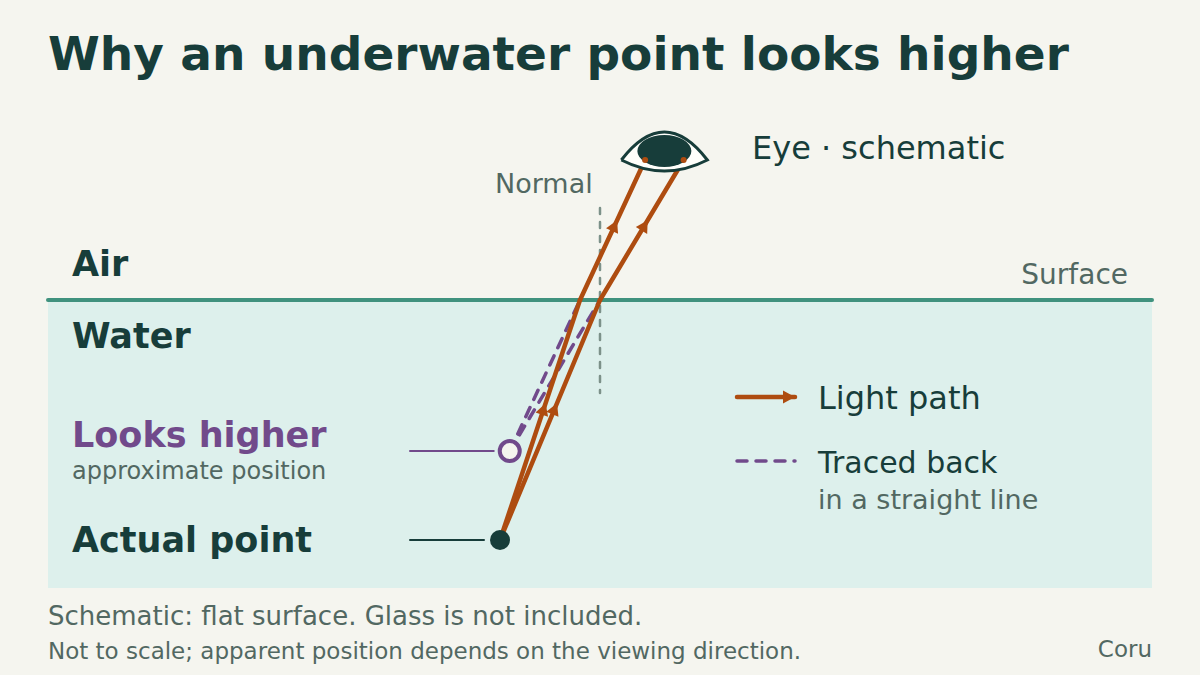
Consider the bowl view, where light crosses just the open water surface. Light reflected from a submerged point travels through water, crosses into air and reaches your eye. At an oblique angle, the transmitted ray bends away from the normal — an imaginary line perpendicular to the surface. Light travels faster in air than in water. A ray crossing exactly along the normal keeps its direction.
The dry part and the submerged part send light to your eye along different paths. Their visible outlines can therefore fail to line up even though the handle itself has not changed.
Why the submerged part appears elsewhere
In a ray drawing, extend the outgoing rays backwards as straight dashed lines. For a narrow bundle of rays, these extensions indicate an apparent position closer to the surface. The actual light follows the solid paths; it does not travel along the dashed extensions.
This apparent position is called a virtual image. The diagram isolates a flat, still water surface and a small bundle of rays. It is a model for explaining the shift, not an exact outline of every spoon from every angle.
Why a round glass adds another effect
Through the side of a tumbler, light also crosses the glass wall. Curved surfaces can change the apparent width and position of the handle. The bowl comparison helps you observe refraction at the open water surface without that side-wall path.
Do not expect the same kink in every container or from every viewpoint. Water depth, handle position, viewing angle and the shape of the vessel all affect what you see.
Check your explanation
Choose an explanation, or open the answers below.
Answers and explanations
- Changing the viewpoint changes the light paths reaching my eye: Yes. Different viewing positions select different paths through the water and air. The apparent alignment can change while the handle stays straight.
- The water bends the metal back and forth as my head moves: Moving your head does not require the handle to change shape. Refraction changes where the submerged section appears.
- Water must give the handle exactly the same apparent kink from every angle: The apparent shift depends on the viewing geometry. The glass wall can add further distortion.
What this observation can tell you
The comparison connects an apparent bend to the viewing path and checks that the handle has remained straight. It does not measure the speed of light or the refractive index of water. Those need a controlled measurement of angles or another suitable experiment.