Why does a cold glass get wet on the outside?
The water on the outside of an intact cold glass usually comes from the surrounding air. Invisible water vapor turns into liquid on the cold surface: condensation. The drink does not need to pass through the glass.
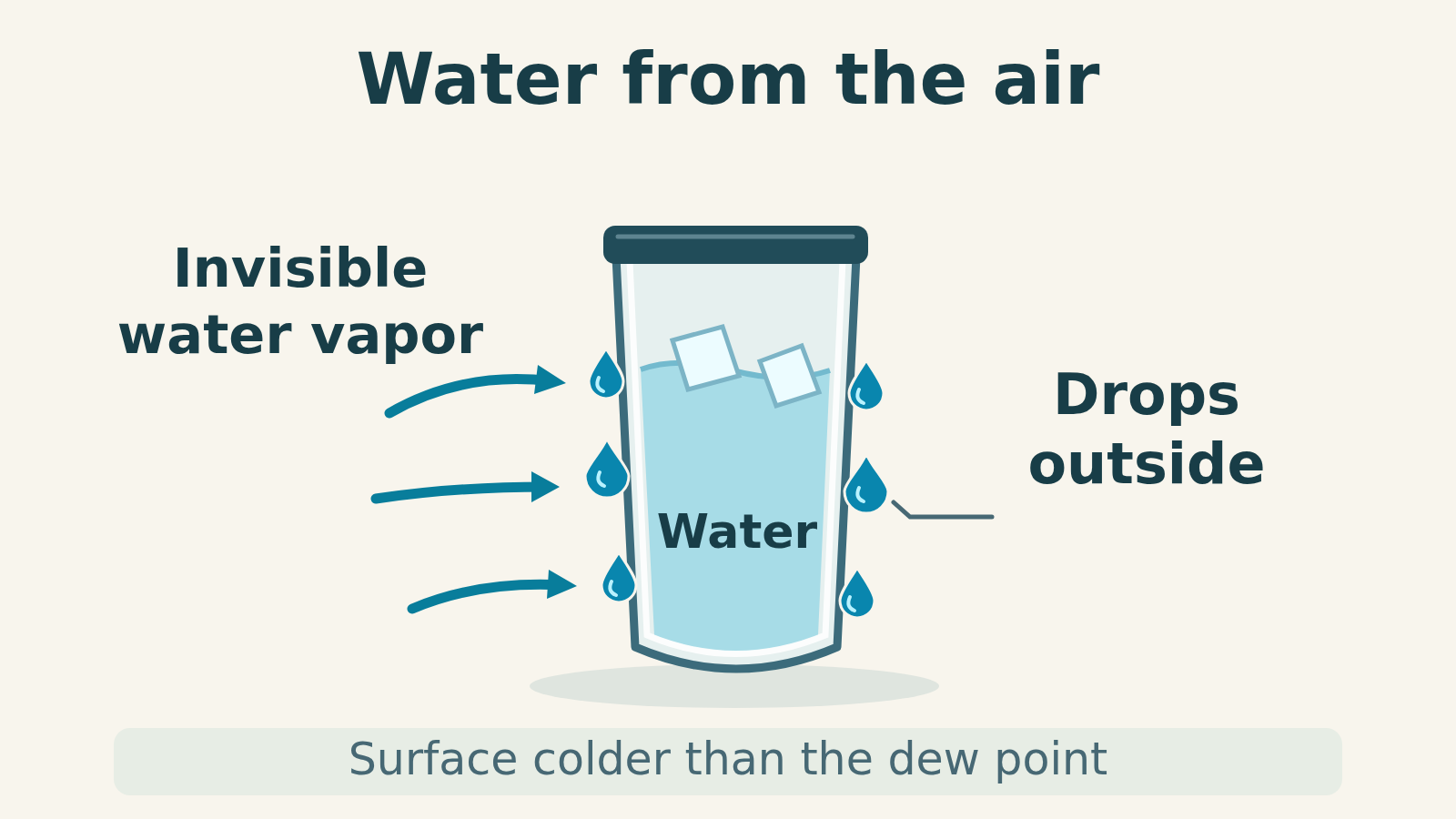
The water is already in the air
Water vapor is water in its gaseous state. It is invisible; the droplets you can see on the glass are liquid water.
The drink cools the glass. When the outside is cold enough, some water vapor from the surrounding air condenses there. Small drops grow and merge; larger ones can run down and make a ring on the table. A closed bottle can do this too.
Cold enough means below the dew point
The dew point is the temperature at which air becomes saturated when cooled without changing its water-vapor content or pressure. If the glass surface is below the surrounding air’s dew point, condensation can form on it.
“Colder than the room” alone is not a sufficient test. In dry air, the dew point can be far below room temperature: a cool glass may stay dry. With more water vapor at the same air temperature and pressure, the dew point is higher.
As the drink and glass warm, new condensation slows or stops once the surface is no longer below the dew point. Existing drops can remain for a while; they do not disappear at a single threshold.
Try a comparison with two closed containers
Use two similar, intact, uninsulated bottles or jars with tight lids, each containing a similar amount of water. Leave one at room temperature and chill the other in a refrigerator. Keep both closed during the comparison.
- Dry both outer surfaces, including the lids. Put the containers next to each other on separate dry plates, away from direct sun, splashes and a heater.
- Note which container is cold and which is at room temperature. Look after about 2, 5 and 10 minutes without handling them.
- For each observation, record “dry”, “fine mist” or “separate drops”. Note whether moisture is spread across the outside or starts at a particular opening or crack.
- Compare the two containers. In sufficiently humid air, you would expect more condensation on the cold one. These observation times are convenient checkpoints, not a promise that drops will appear.
A small observation sheet
Copy these three lines onto paper and fill in the gaps. “Fine mist” here means tiny liquid drops on the surface, not visible water vapor.
- After 2 minutes — cold container: ___ ; room-temperature container: ___
- After 5 minutes — cold container: ___ ; room-temperature container: ___
- After 10 minutes — cold container: ___ ; room-temperature container: ___
What the comparison can tell you
Moisture appearing mainly on the cold container supports the role of a cold surface. The lid reduces splashes and direct evaporation from the contents into the room. The comparison is an illustration, not a measurement of the dew point or a proof that a particular bottle has no leak.
If both stay dry, the cold surface may not be below the dew point, or there may be too little condensation to see yet. If both get wet, check for remaining rinse water, splashes and whether the supposedly room-temperature container was actually still cold.
For a suspect container, inspect the lid and wall separately. Water repeatedly emerging from one damaged spot is a different observation from widespread tiny drops. Condensation and a leak can also happen together.
Check the explanation
Consider an intact, tightly closed bottle in humid room air. Its outside is colder than the air’s dew point. Choose the explanation for new drops on the outside, or open the answers below.
Answers and explanations
- Only from liquid escaping through the bottle wall: A leak is not required. Water vapor from the room can condense on the outside of an intact bottle.
- From water vapor in the surrounding air: Yes. The cold outer surface allows water vapor in the air to become liquid there.
- The cold surface creates new water: Cooling changes water’s state; it does not create the water. The surrounding air already contains water vapor.
The same idea, elsewhere
Dew on grass and moisture on the inside of a cold window also involve water vapor becoming liquid on a cool surface. For the window, the relevant air is the air on the side where the drops form.
A useful question is therefore: “Which surface is cold, and which air touches it?” That is more precise than saying an object is “sweating”.