Why does metal feel colder than wood at the same temperature?
Metal can feel colder than wood at the same temperature because it draws heat away from warmer skin more quickly. Your sensation reflects what happens to your skin during contact; it is not a direct thermometer reading of the object.
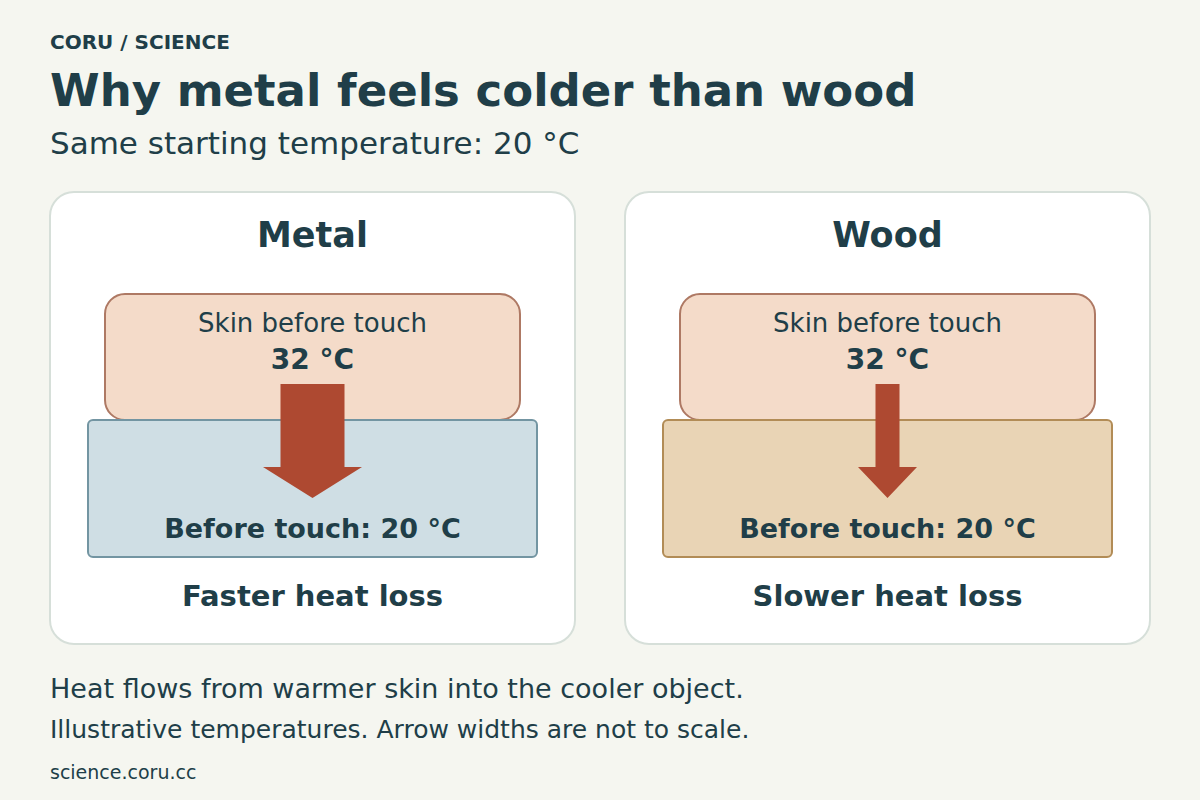
One starting temperature, two sensations
Imagine a metal spoon and a dry wooden spoon that have spent a long time together in a room, away from sunlight, heaters and cold draughts. If both have settled to the same surrounding temperature, the metal can still feel colder. The important condition is that both are cooler than your skin.
The picture uses 20 °C for the objects and 32 °C for skin as illustrative starting values. They are not measurements of your room or your hand. Touching the objects begins to change the temperatures near the contact.
Follow the heat out of your hand
Heat flows from warmer skin into the cooler object. Metal carries energy away from the small contact area readily, so that area does not warm as quickly as it would in a comparable piece of wood. Your skin can cool more rapidly against the metal. That change helps produce the stronger cold sensation.
Wood transfers heat less readily. Its surface near your hand warms more easily, reducing the temperature difference at the contact. It can therefore feel less cold even though it started at the same temperature. There is no need to imagine “cold” flowing out of the metal.
Why “metal conducts heat” is only the short answer
Thermal conductivity describes how readily heat moves through a material. The initial contact also depends on how much energy the material can absorb as its temperature changes. A property called thermal effusivity combines conductivity, density and specific heat capacity.
You do not need its formula for the comparison. But it explains why conductivity alone cannot predict every touch sensation. Thickness, coatings, moisture, contact pressure and how long you touch also matter. A thin metal film on wood need not behave like a thick metal block.
A small comparison you can try
Use only clean, dry, smooth objects you know are at a comfortable indoor temperature. A metal spoon and an unheated wooden utensil are enough. Do not heat or refrigerate them for this activity.
- Leave them together away from direct sunlight and heat sources long enough to approach room temperature. There is no universal waiting time for every object.
- Before touching, write your prediction: which will feel colder, or will they feel alike?
- Briefly touch each with your fingertips in a similar way. Record the sensation: for example, “the metal felt colder on first contact”.
- Let them settle again before repeating. Your hands warm small objects, so immediate repeated touches change the comparison. If the sensations are unclear, record that too.
What this observation can — and cannot — show
The result is a report of what you felt. Touch alone cannot establish equal starting temperatures. “Both were in the room” is a useful preparation, not a temperature measurement. A real temperature difference, different contact area or a coating could also affect your result.
For a measurement, use a thermometer designed for surface contact and follow its instructions. An infrared thermometer is not a simple shortcut on shiny bare metal: low emissivity and reflected radiation can mislead its reading. A cooler-looking number on the display may need investigation.
Would metal always feel colder?
No. Consider the reverse situation only as a thought experiment: both objects start at the same temperature above that of your skin. Heat now flows towards your hand. A metal surface can then feel hotter because it transfers heat to your skin readily. Do not test this by touching heated objects.
At the same temperature as your skin, the initial temperature difference driving this heat transfer disappears. The practical lesson is to separate three questions: what temperature did the object start at, which way does heat flow, and how quickly does contact change your skin temperature?
Check the explanation
Make your prediction, then use the buttons or open the answers and explanations below. This is a thought experiment; do not touch heated objects.
Answers and explanations
- The metal must still feel colder.: Metal has no fixed coldness. First ask which side is warmer: here heat would flow into the skin.
- The metal can feel hotter.: Yes. The temperature difference is reversed, so efficient transfer can warm skin more quickly.
- They must feel identical because their temperatures match.: Equal object temperatures do not guarantee equal rates of heat transfer to skin.
Sources & further reading
- American Physical Society — Getting Warmer, Getting Colder
- University of Illinois Physics Van — Why do metals feel cold?
- Exploratorium — Cold Metal
- Purdue University — Interactive Heat Transfer
- National Physical Laboratory — Why is emissivity important?
- Chen and Ding (2019) — Thermal tactile perception and contact resistance
- MIT — Influence of contact conditions on thermal responses of the hand