Make a sound map: two rounds, ten minutes
Put yourself in the centre, number the sounds and keep guesses separate. Two short maps show what you noticed each time.
Make two small maps, then compare them
A sound map is a sketch of what you hear around one listening place. You do not need to recognise birds, record audio or measure decibels. A pencil, paper and about ten minutes are enough for this version.
Use two three-minute listening rounds in the same place. Put each sound in roughly the direction you hear it, then write separately what you think made it. The useful result is a record you can explain, including what you do not know.
Download the sound-map sheet (A4)
One printable page with two map panels and five rows for notes. Print at 100% or fit to page. No printer is needed: draw the boxes and notes on plain paper instead.
1. Set up the page — one minute
Choose somewhere you can sit or stand comfortably without blocking a path. A courtyard, garden or park bench works; an indoor seat by a window is another option. Keep your eyes open when you need to watch your surroundings. Do not walk while drawing.
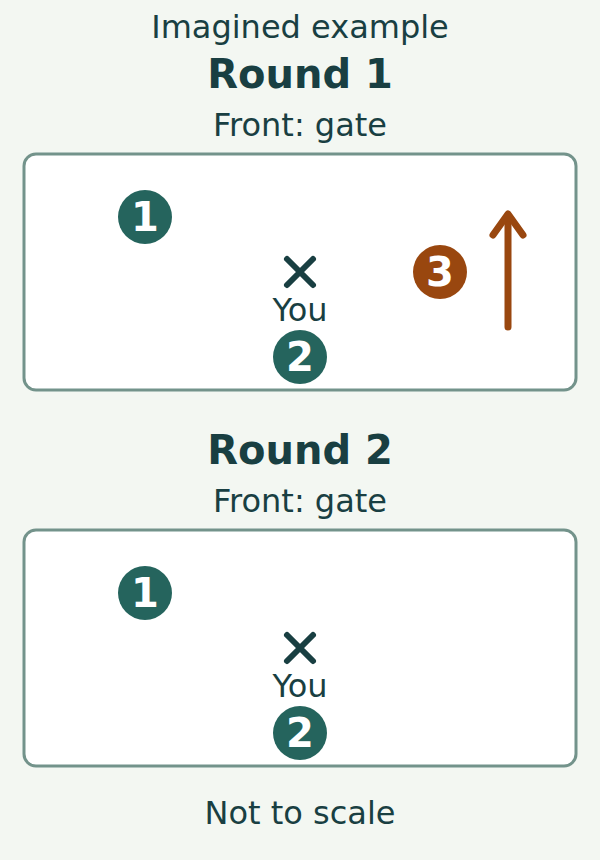
Draw two boxes and mark yourself with an X in the centre of each. The top means in front of you. Write what you are facing, such as “the red gate”, so that left and right keep the same meaning in both rounds. Add the date, start time, place and conditions, such as “light wind; window open”.
The drawing is not to scale. Use the space to show approximate direction; you do not have to guess a distance. If you cannot place a sound, write its number beside the box with a question mark.
2. First round — three minutes
Listen from your chosen spot. Give a sound an ID, starting with 1. Put the number on the first map and use the same number in the notes. A brief description such as “three high chirps” is more useful than a confident animal name you have not checked.
Keep the description and possible source separate: “steady low hum” describes what you heard; “ventilation fan?” is a guess. Use an arrow only if you hear the source moving. A question mark can mean the source or direction is uncertain.
- Number: an entry you can find in the notes. Use the same number if you recognise that sound in round two.
- Arrow: the direction of movement you heard, not merely a line pointing towards the sound.
- Question mark: a guess or an uncertain direction. You may leave the source blank.
3. Second round — three minutes
Stay in the same place and face the same way. Use the second box. Keep existing IDs for sounds you recognise; give a new sound a new number. If you are unsure whether it is the same sound, make a separate entry and note the uncertainty.
In the notes, tick a round when you noticed that sound. Use a dash when you did not notice it. A dash does not prove the sound or its source was absent. The five rows on the sheet are a starting space, not a target; use extra paper if you need it.
A worked example — invented, not a field recording
Imagine sitting on a bench facing a red gate. In round one, you mark 1 at the front left for three high chirps, 2 behind you for a steady hum and 3 on the right with an arrow from behind-right to front-right for rumbling and rattling. In round two, you hear 1 and 2 again; you do not notice 3.
Example notes
ID  What I heard       Possible source  Round 1  Round 2
1   Three high chirps  Bird?            yes      yes
2   Steady low hum     Fan?             yes      yes
3   Rumble and rattle  Bicycle?         yes      —
The words describe sounds; the question marks preserve guesses. Number 3 was not noticed in round two. It is not a confirmed bicycle count.
4. Compare — three minutes
Write one observation and one unanswered question. For the example: “I noticed rumbling and rattling only in the first round. I do not know what made the low hum.” That conclusion follows from the notes without turning guesses into facts.
Three sound entries do not mean three animals, three species or three physical objects. One source can make different sounds; different sources can sound alike. This sketch also does not measure sound level or establish whether a place is quiet, safe or rich in wildlife.
- Which entries did you notice in both rounds, and which in only one?
- Did a direction become clearer, or does it still need a question mark?
- Did conditions change, such as a window closing or wind starting? Record the change before comparing.
Make the activity fit you
For a shorter version, try two one-minute rounds and note the actual times. If listening or locating sounds is difficult, work with someone who describes what they hear while you draw; label the sheet as a shared observation. Different maps are not a competition or a hearing test.
You can instead make a visual map of movement: leaves shaking, a passing person, a turning wheel. Label it a movement map, because it records a different kind of observation. A repeat visit at another time can start a new sheet; keep the place, orientation and duration in the notes.
Where the activity comes from
Sound mapping is an established educational activity. The National Park Service guide places the listener at the centre and marks sounds in approximate directions, with uncertain source labels allowed. The National Education Nature Park guide also suggests describing sounds with marks and working with a partner.
Coru’s two-round schedule, ID system, invented example and printable layout are original additions. The ten-minute plan is a suggestion, not a method tested with participants by Coru.