Why do days get shorter in autumn?
During autumn at northern mid-latitudes, a place spends less of each rotation on Earth’s sunlit side. The cause is Earth’s tilted axis and its journey around the Sun. The Southern Hemisphere has the opposite seasonal pattern.
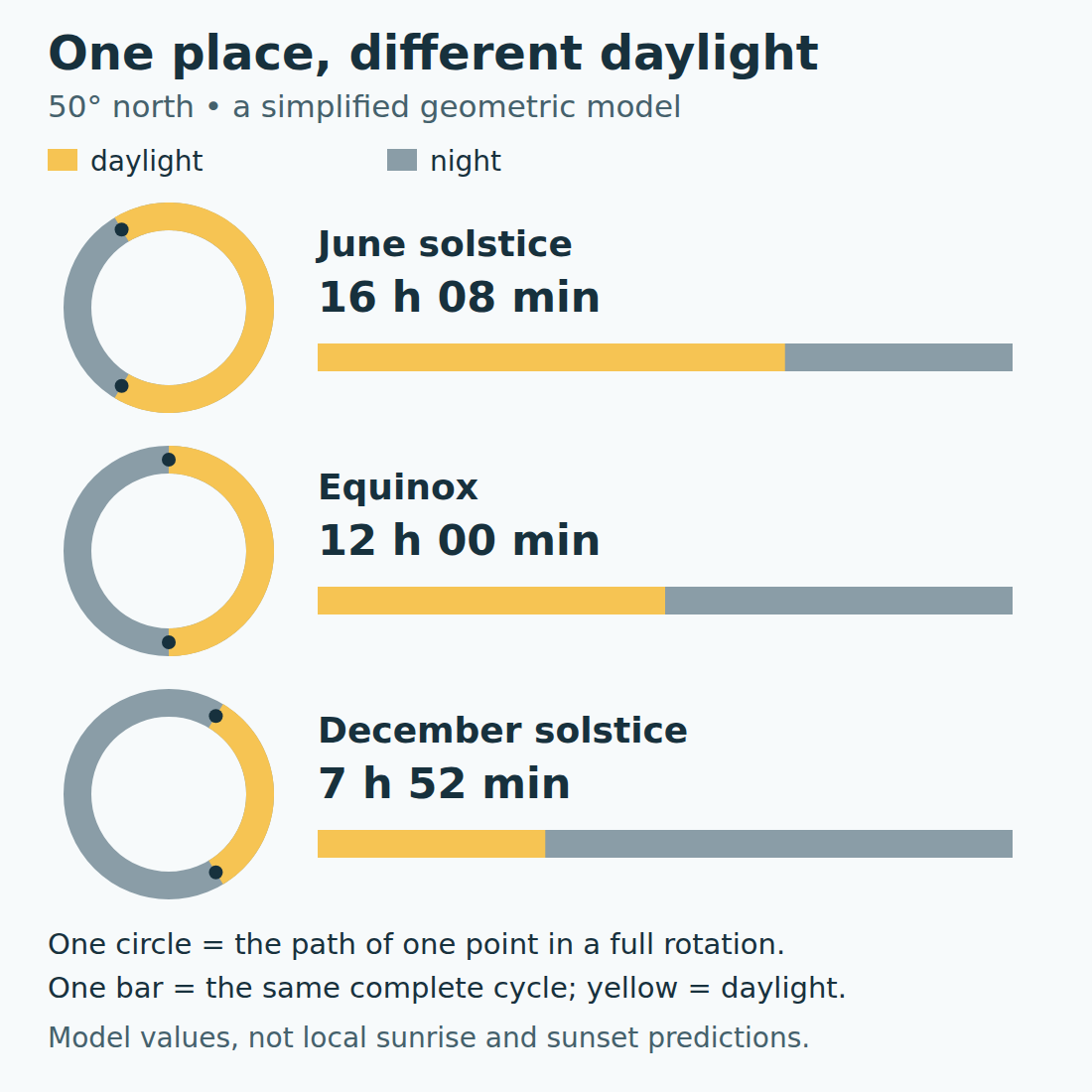
What gets shorter?
“A shorter day” usually means less time between sunrise and sunset. It does not mean Earth suddenly starts spinning faster. During twilight the sky can remain bright after sunset, so visible light and sunrise-to-sunset duration are not exactly the same thing.
At northern mid-latitudes, daylight decreases through autumn toward the December solstice. The same months bring spring and increasing daylight at southern mid-latitudes. Start with your hemisphere, not just the month.
Follow one place through a rotation
Imagine a small sticker marking your town on a globe. As Earth rotates, that place moves into sunlight and later into darkness. Its path around the rotation axis is a circle at its latitude. The fraction of that circle on the sunlit side determines how much of a rotation is daytime.
Earth’s axis is tilted about 23.4° from the direction perpendicular to its orbital plane. As Earth travels around the Sun, the axis keeps nearly the same direction in space. It does not lean farther over every autumn.
During northern autumn, the Northern Hemisphere becomes increasingly turned away from the Sun. For a northern place such as 50°N, less of its daily circle lies in sunlight. Sunrise-to-sunset time decreases. Meanwhile, more of a southern mid-latitude place’s circle lies in sunlight.
Three useful checkpoints
- Near the September equinox: away from the poles, daylight and night are approximately equal. Sunrise and sunset use the Sun’s edge, and the atmosphere bends sunlight, so the equinox does not guarantee exactly 12 hours between them.
- Near the December solstice: northern mid-latitudes have their shortest daylight of the year; southern mid-latitudes have their longest. The seasonal trend then reverses, although polar night or continuous daylight can persist at high latitudes.
- Latitude matters: the annual change is small near the equator and much larger toward the poles. Within polar regions, some dates have no sunrise or no sunset.
Why distance and clock changes do not explain it
Earth is actually closest to the Sun around early January, during northern winter. Distance cannot explain opposite seasons happening at the same time in the two hemispheres. Tilt changes both the length of daylight and the angle at which sunlight reaches the ground.
If clocks are moved back, sunset gets an earlier clock label. That does not remove an hour of sunlight. Compare the duration from sunrise to sunset, using the same time convention, rather than comparing sunset clock readings alone.
Try a small lamp-and-globe model
Use a stable, cool LED lamp and a globe, or a ball with removable stickers. Keep the ball clear of the lamp. You need no sharp supports or hot bulbs, and you should never look directly at the Sun. This is an activity to try, not a report of a measured experiment.
- Mark the north pole and a place halfway between pole and equator. Imagine a straight axis through the two poles. Tilt it slightly and choose a wall toward which its north end will keep pointing.
- Put the ball on the side of the lamp where the north end leans toward the light. Slowly rotate it about that tilted axis. Watch the town sticker enter and leave the illuminated part.
- Move the ball to the opposite side of the lamp, keeping its north end aimed at the same wall. Rotate it again with the same tilt. The northern sticker should spend a smaller part of its circuit in light.
- Compare the two circuits, not the speed of your hands. A nearby lamp, room lighting and imperfect rotation make this a qualitative model; it cannot give accurate sunrise times.
Check the other hemisphere
Think about the place’s hemisphere and the part of its daily circle in light. Choose an answer or open the explanations below.
Answers and explanations
- Daylight gets longer; more of the town’s daily circle is lit: Yes. This is southern spring moving toward summer. More of that place’s daily circle lies in sunlight.
- Daylight gets shorter; less of the town’s daily circle is lit: That is the northern seasonal pattern for these months. At 35°S, daylight increases toward the December solstice.
- Daylight gets longer because Earth spins much more slowly: Daylight increases because a larger share of the town’s daily circle is lit, not because Earth suddenly slows its rotation.