Why do mirrors reverse left and right, but not up and down?
In an upright flat mirror, your right hand stays on the same side of the room. The reflection reverses the direction perpendicular to the mirror: front to back. The apparent left–right swap comes from comparing that reflection with a person who has turned to face you.
Follow a point through the mirror
Imagine a small orange mark on your right hand. Stand facing an upright flat mirror. The image of the mark stays on the same side of the room as the mark itself; it also stays at the same height. Its apparent position is behind the mirror, as far behind as the real mark is in front.
This is a virtual image: reflected light reaches your eyes from the mirror. Light does not travel behind it to make another hand.
A map from above
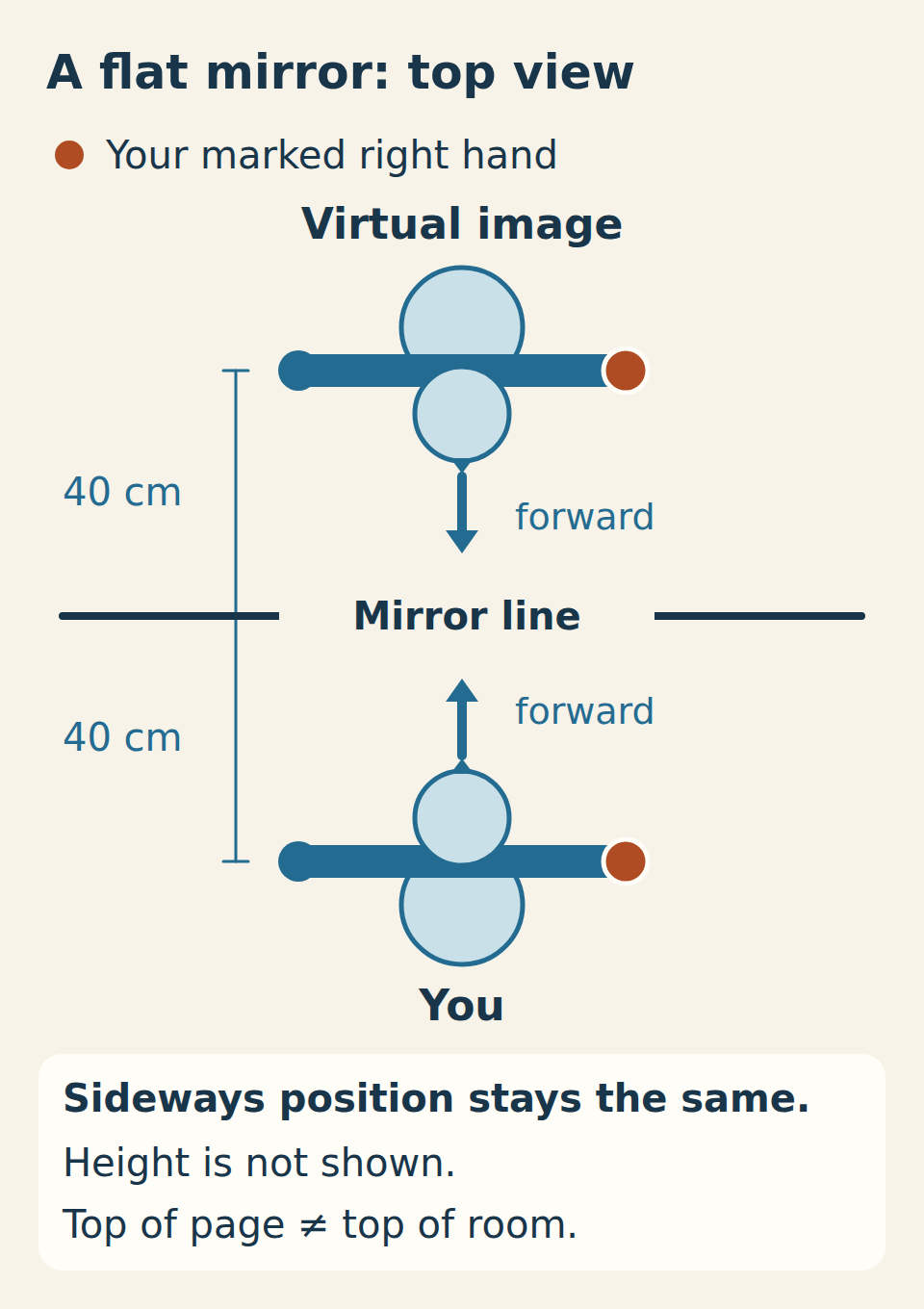
Read this diagram like a floor plan. The top of the drawing means farther into the room beyond the mirror, not higher above the floor. The orange mark keeps its sideways position. The direction the person faces changes across the mirror.
The two 40 cm marks compare the distance of the marked hand and its image from the mirror. The arrows show which way each figure faces, not light rays. Height is absent from this top view; an upright flat mirror preserves it too.
Why the reflected hand looks like a left hand
Imagine a person standing where the image appears, facing you. Their left side is on your right. The reflected version of your right hand has the shape of a left hand, and occupies the place you would call that person’s left hand.
But turning a real person halfway around and reflecting them are different operations. An upright half-turn changes both their front–back direction and their position left or right of their own centre. Reflection changes only the direction perpendicular to the mirror. That is why the two results do not match.
Turn a paper card two different ways
Write a large R near the left edge of a card, with a dot near its top edge. Start with the writing facing you and the mirror behind the card. Keep the card upright and roughly parallel to the mirror. Use the same starting position for each trial.
- Trial 1: turn the card halfway around a vertical axis, as if opening a door. The writing now faces the mirror. In its reflection, the R is reversed left to right and moves to the right side of the card, while the dot is still near the top.
- Trial 2: return to the starting position. Turn the card halfway around a horizontal axis, bringing its top edge over towards you. The writing again faces the mirror. This time the reflection flips the drawing top to bottom: the dot is near the bottom and the R stays on the left.
- Compare the whole card, including the dot. “Upside down” alone is ambiguous: a top–bottom flip is different from rotating a drawing flat on the table by half a turn.
Check the rule with three measurements
Here is an invented position to test the geometry. Measure sideways from a fixed mark on the mirror, height from the floor, and depth from the mirror’s surface.
- Real mark: 25 cm to the right of the reference, 140 cm above the floor, 40 cm in front of the mirror.
- Image: the same 25 cm to the right, the same 140 cm above the floor, and 40 cm behind the mirror.
- Move the real mark 10 cm closer. Its image is now 30 cm behind the mirror, not 50 cm. The mark and image are 60 cm apart in this geometric model.
What if the mirror is horizontal?
The rule follows the mirror’s surface. For a horizontal flat mirror, the perpendicular direction is vertical, so height is reflected across that surface. There is no special preference for left and right. The upright-mirror explanation above does not describe a curved mirror or a phone app that may flip a preview.