Tashkent hit 34°C. Vladivostok hit 26°C. Who needed the jacket?
You have two tickets for August 18, 2016, and one jacket. Around Tashkent the temperature topped out at 34°C. Around Vladivostok, on the coast, it reached 26°C. Send the jacket to whichever place had the cooler hour.
Where does the jacket go?
Compare the lowest hourly temperatures on the same local date.
Answers and explanations
- Vladivostok: Vladivostok moved through just 4.5 degrees that day. Its low was close to 22°C. Try the other ticket.
- Tashkent: Tashkent dipped to 20.1°C. Vladivostok bottomed out at 21.9°C.
Answers and explanations
- Vladivostok: Vladivostok moved through just 4.5 degrees that day. Its low was close to 22°C. Try the other ticket.
- Tashkent: Tashkent dipped to 20.1°C. Vladivostok bottomed out at 21.9°C.
One date could be a fluke. Try thirty Augusts.
A viewer from Tashkent asked a question under our film about winter in Vladivostok. Could the inland city have colder August nights? We tried a head-to-head test, comparing each August date with the same date on the Pacific coast.
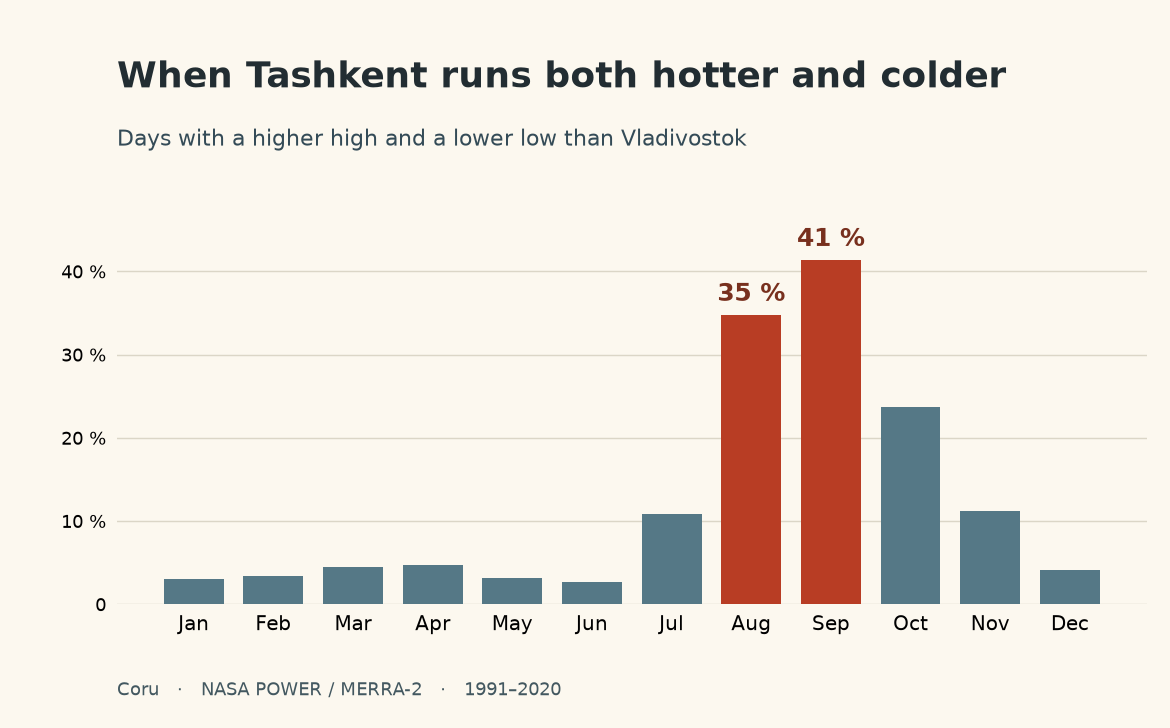
That gave us 930 pairs of days in NASA’s 1991–2020 record. Tashkent had the lower low 327 times. On 323 of those dates it also had the higher high. In roughly one August comparison out of three, the same city took both extremes.
September had the most reversals, with 372 in 900 days. June had just 24 in 900. On the August date you played, the temperature around Tashkent swung through 14 degrees. The high alone gave away only half the story.
Inside the thermometer
We used MERRA-2 reanalysis estimates of air temperature two metres above the ground. For each local solar day NASA POWER takes the highest and lowest of 24 hourly values. Each grid cell covers half a degree of latitude and five-eighths of a degree of longitude. A coastal cell can span land and sea. A thermometer on a particular street can read differently.
We compared all 10,958 local dates from 1991 through 2020. The two places can reach their daily lows at different hours. We compared the values at the precision supplied by NASA and rounded the ticket temperatures to whole degrees.