This Note Is Missing. Listen for It.
Six notes, three versions. Play A, then B at a comfortable volume. Did the melody change pitch, or just its tone colour?
A. The complete sound · 5.5 seconds
A. The complete sound · 5.5 seconds
Transcript
Six notes without speech. The tune rises twice, then returns down in three steps, with short gaps between notes.
B. Lowest component removed · 5.5 seconds
B. Lowest component removed · 5.5 seconds
Transcript
Six notes without speech. The tune rises twice, then returns down in three steps, with short gaps between notes.
We took 200 Hz out of the first note
In A, the first note combines six sine waves: 200, 400, 600, 800, 1000 and 1200 Hz. In B, we did not synthesize the 200 Hz component. We did the same to every note in the tune. Only higher components remain.
Yet you may hear roughly the same pitch. This is the missing fundamental effect: a complex sound’s pitch need not match its lowest actual frequency. Its tone colour, or timbre, changes along the way.
Didn’t hear it? That is a possible outcome too. You can try another familiar pair of headphones at a comfortable level. This page is not a hearing test: listeners and playback devices can give different results.
The clue is between the frequencies
The numbers 400, 600, 800, 1000 and 1200 are still spaced 200 Hz apart. They are whole-number multiples of 200. In its steady portion, B’s waveform repeats every 5 milliseconds, although we added no separate 200 Hz sine wave.
That pattern gives the auditory system clues to a low pitch. It does not mean your brain literally draws a new sound wave in the air. We are talking about perceived pitch; this home comparison cannot establish its precise mechanism.
Now remove more than the bottom one
C keeps only the even harmonics: 400, 800 and 1200 Hz for the first note. Its lowest frequency is still 400, just as in B. But its series is now built around 400, and the waveform repeats every 2.5 milliseconds. Compare B with C: C is expected to sound an octave higher.
C. Even harmonics only · 5.5 seconds
C. Even harmonics only · 5.5 seconds
Transcript
Six notes without speech. The tune rises twice, then returns down in three steps, with short gaps between notes.
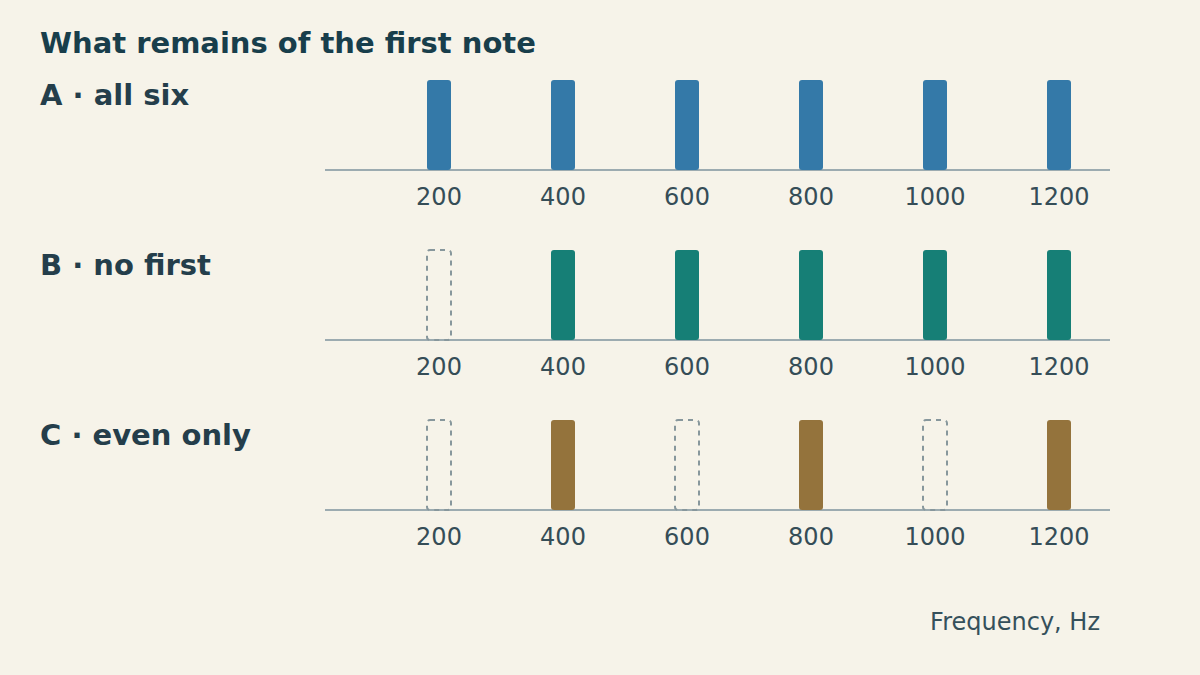
One lowest frequency, two pitches
B and C share their lowest component. Their neighbours make the difference: 600 and 1000 Hz help B retain the pattern of a series spaced 200 Hz apart. Remove them and the spacing becomes 400.
Go back to A and B. If their pitches seem similar, you have heard something important: crossing the bottom line out of a spectrum is not enough to move the whole tune up an octave. The whole pattern matters.
Inside the files
Coru created all the sounds and this six-note sequence from sine waves, without sampled music or voices. Note durations, gaps and root-mean-square sample levels match across versions; that does not guarantee equal perceived loudness. Note edges are smoothed. The WAV files are mono, 48 kHz, 16-bit.
We checked the steady portions’ frequencies in the finished files and verified that they do not digitally clip. Actual speakers, headphones and playback chains can add distortion. The missing component therefore describes our synthesis, not an independent measurement at your ear. This illustrates a known phenomenon; it does not measure its strength in an individual listener.