Why does water evaporate without boiling?
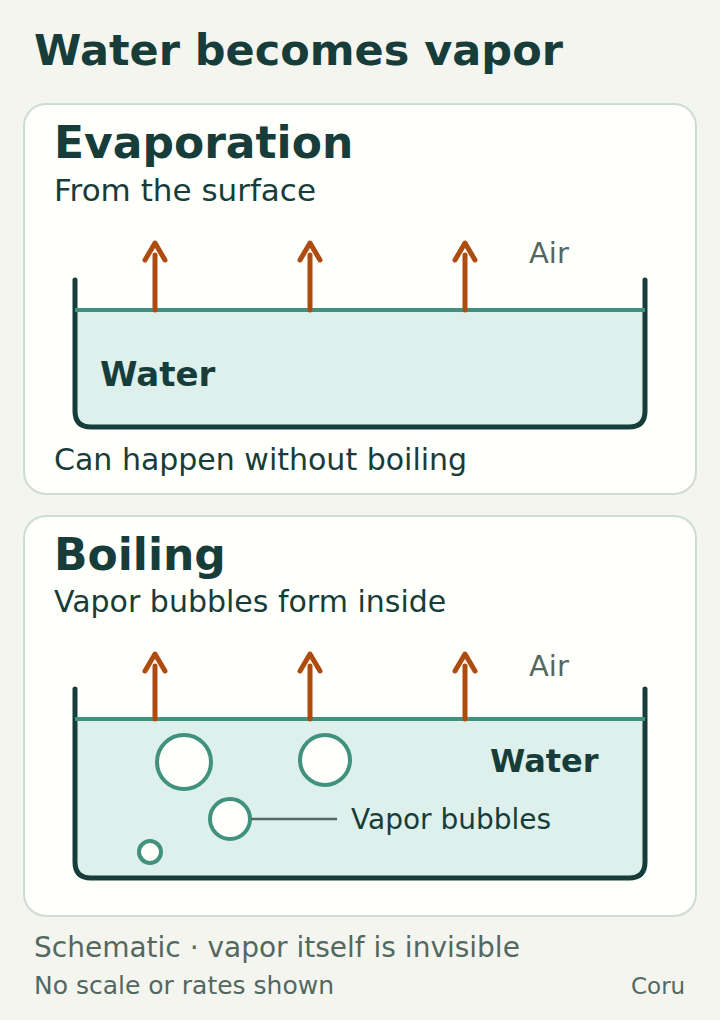
Water can leave a wet shirt or a puddle as invisible water vapor at temperatures well below its boiling point. Evaporation happens at the liquid’s surface. Boiling also creates growing bubbles of vapor inside the liquid.
The boiling point is not a starting line
A wet shirt on a drying rack does not need to reach 100°C. Molecules in liquid water are continually moving and interacting. Some at the surface can overcome their attraction to neighboring molecules and enter the gas above it. The whole puddle does not have to become hot first.
The water has changed state, not vanished or turned into air. Water vapor mixes with the other gases around the shirt. Individual molecules can also return from the gas to the liquid. The shirt loses water overall when more water leaves it than returns.
How boiling is different
During boiling, bubbles containing water vapor can grow within the liquid and rise to its surface. For pure water at normal atmospheric pressure, the boiling temperature is about 100°C; a different pressure changes that temperature. Surface evaporation can happen well below it, and continues during boiling.
Do not use every tiny bubble as evidence of boiling: warming water can also release dissolved air. And visible white mist is made of tiny liquid droplets, not the invisible water vapor itself.
Room-temperature drying still needs energy
Turning liquid water into gas takes energy. A stove is one way to supply it, but the surrounding air, a surface beneath the water, or sunlight can also transfer energy. There need not be an obvious heater.
Evaporation can cool the wet surface as energy is used in the change of state. That helps explain the cool feeling of wet skin. It does not mean the surface must keep getting colder indefinitely: its temperature also depends on heat arriving from its surroundings.
Why spreading out and moving air help
Several conditions work together. These comparisons assume the other relevant conditions stay similar:
- Warmer water generally evaporates faster. Temperature affects molecular motion and the vapor pressure associated with the water surface.
- More water vapor already near the surface reduces the net loss, at fixed water and air temperatures. “Humid” is therefore relevant to drying, not just how the weather feels.
- Moving air can carry away the moist layer next to a wet surface and replace it with drier air. This can help clothes dry on a cool day; wind does not have to make the water boil.
- A larger exposed wet area generally allows more water to evaporate in a given time. Opening out a towel exposes more wet fabric than leaving it folded in a pile.
Try two saucers, without heating
Use two matching, dry, nonporous saucers with rims, room-temperature water, a teaspoon, and transparent food wrap. Place them together on a stable tray, away from direct sun, heaters, splashes and electrical equipment. Use plain water only.
- Put the same amount of water in each saucer, for example two level teaspoons from the same spoon. Label them A and B. Photograph or sketch their starting appearance.
- Leave A open. Stretch food wrap tightly across B and seal it around the rim without touching the water. Keep the cover in place throughout the observation.
- Look after roughly one hour, four hours and the next day. Record water remaining, any droplets on the cover, and spills or changes in the room. These are checkpoints, not promised drying times.
Record loss, not just a smaller puddle
Copy this line for each checkpoint: time ___ ; A appearance ___ ; B water and cover ___ ; room changes ___ . A puddle’s outline alone is not an accurate measurement of its volume. Half the width does not mean half the water remains.
If you have a suitable scale, weigh each entire setup at the start and at the same checkpoints. Include B’s cover every time, use the same scale and keep the undersides dry. Compare each setup with its own starting mass. A change smaller than the scale’s resolution is not a measured loss.
What the comparison can show
In suitable conditions, the open setup should lose more water to the room. In the covered setup, water may evaporate and condense on the cover while staying inside the setup. A sealed container does not stop all molecular exchange between liquid and vapor.
Covering changes local humidity and airflow, and can also change temperature. This comparison illustrates restricted escape; it does not measure those effects separately. We have not run this physical trial.
If the result is unclear, record that. Too little time, humid air, a leaky cover or an insensitive scale can hide the difference. An unclear result is worth recording; repeat with fresh equal amounts if needed.
Check the explanation
A wet shirt dries in a room well below water’s boiling temperature. Choose an explanation, or read the answers below.
Answers and explanations
- It evaporated from wet surfaces into the surrounding air.: Yes. Water can enter the gas phase from a liquid surface below the boiling point.
- Small parts of the shirt must have reached 100°C.: No. Surface evaporation does not require the shirt to reach the boiling temperature.
- It stopped being water when it became invisible.: No. Water vapor is still water, in its gaseous state.