Why does ice float in water?
Ordinary ice floats in fresh water because it has less mass than an equal volume of liquid water. Freezing creates an open crystal structure, lowering density. The water can support the ice before the whole piece is submerged.
Start with equal volumes
“Ice is lighter than water” leaves out a crucial comparison: how much ice and how much water? A large block of ice can have much more mass than a spoonful of water and still float. Compare equal volumes instead.
Density means mass divided by volume. For a simple calculation, use about 0.92 grams per cubic centimeter (g/cm³) for compact freshwater ice near its melting point and about 1.00 g/cm³ for fresh liquid water. One cubic centimeter has the same volume as one milliliter.
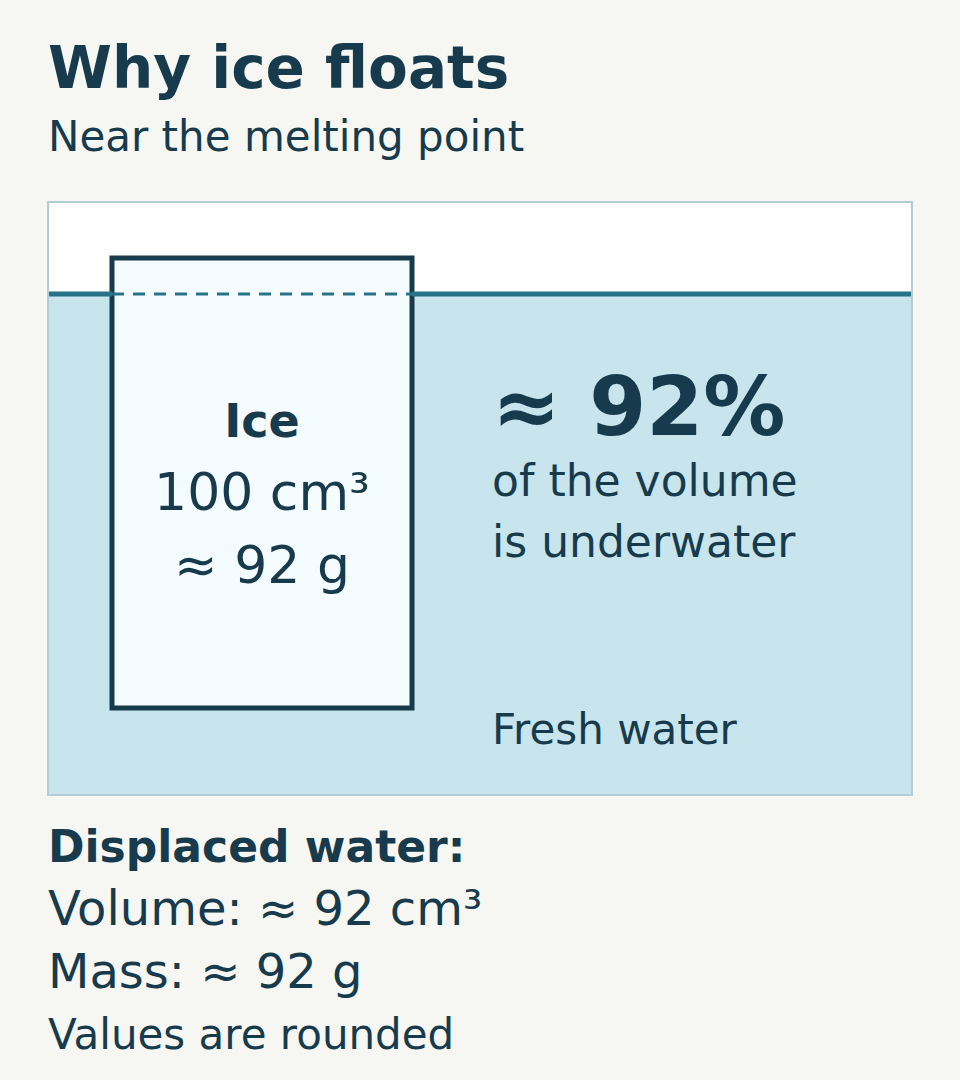
So 100 cm³ of ice has a mass of about 92 g; 100 cm³ of liquid water has a mass of about 100 g. The volumes match, but the ice contains less mass. These rounded values describe an example, not a measurement of your freezer’s ice cubes.
What changes when water freezes?
Water molecules attract one another through interactions called hydrogen bonds. In ordinary ice, these interactions hold the molecules in an ordered, relatively open crystal structure. In liquid water the arrangement keeps changing, and the molecules can pack more closely overall.
The expansion comes from the arrangement of the molecules, not from each water molecule swelling up. If no water is added or lost, freezing leaves essentially the same mass occupying a larger volume. A larger volume for the same mass means a lower density.
The molecules in ice still vibrate; “solid” does not mean motionless. Nor does “solid” automatically mean denser than the liquid. The structure matters.
How water holds the ice up
Water exerts pressure on the ice. The combined effect is an upward buoyant force. Archimedes’ principle says that this force equals the weight of the water displaced by the submerged part.
Imagine the submerged ice removed and its space filled with water: that is the displaced volume. For a freely floating piece at rest, the upward buoyant force balances gravity’s downward pull on the ice. The displaced water therefore has the same mass as the ice. This simple model of an ordinary cube neglects surface tension.
Follow the 100 cm³ block
Our block has a mass of about 92 g. At about 1 g/cm³, 92 g of water occupies about 92 cm³. The block therefore needs about 92 cm³ below the surface to displace enough water to support it. About 8 cm³ remains above.
The calculation is: submerged volume ÷ total volume ≈ 92 ÷ 100 = 0.92. So roughly nine-tenths of the ice’s volume is underwater. Being able to float does not mean sitting mostly above the surface.
The diagram uses an upright block with the same horizontal cross-section at every height. For this geometry, the submerged height has the same fraction as the submerged volume. A tilted, tapered or rounded ice cube can show a different height fraction. Do not measure its visible tip and call that a volume measurement.
Look at an ordinary ice cube
Use a clear cup, fresh room-temperature water and an ordinary ice cube. Choose a cup wide and deep enough for the cube to float without resting on the bottom.
- Partly fill the cup, leaving space for the ice. Lower the cube gently into the water.
- Let the water settle. Check that the cube is floating freely, away from the side and bottom. Look for the waterline and the small part above it.
- Sketch what you see. Record “mostly below the surface” separately from any estimate of a percentage. As the cube melts, its shape and orientation may change.
What the observation does and does not show
The cup lets you observe floating with most of the ice submerged. It does not reveal molecular structure or provide a precise density measurement. The explanation connects that everyday observation to independently established properties of ice.
The approximate fraction here is for compact ordinary ice floating in fresh water. Air trapped in the ice, dissolved substances in the water and temperature affect densities. It is not a fixed percentage for every ice sample in every liquid.
Check the idea
Choose an answer or open the explanations below.
Answers and explanations
- Both float, with approximately the same fraction of their volume underwater: Yes. Ten times the mass also means ten times the volume at the same density. The larger piece displaces ten times as much water, but the submerged volume fraction stays approximately the same.
- The larger piece must sink because it is heavier: Its mass is larger, but so is the volume available to displace water. Mass alone does not decide whether it floats.
- Both must have exactly the same height above the water: The density ratio predicts a volume fraction, not a fixed height. The pieces’ sizes and shapes also matter.