Why does a rubbed balloon attract neutral paper?
A rubbed balloon can attract a piece of neutral paper because it slightly rearranges the paper’s bound charges. Try a slow approach before and after rubbing, then separate what you observed from what it proves.
Neutral does not mean no charges
Paper contains positive and negative electric charges. A neutral piece has equal total amounts of the two; it does not contain no charge at all. A charged balloon can disturb their arrangement without touching the paper.
In the simplified example below, the balloon is negatively charged. The nearby paper becomes polarized: within its atoms and molecules, bound positive and negative charge shift slightly relative to one another. The positive side lies nearer the balloon. This is a small local rearrangement, not electrons travelling freely across a sheet of paper.
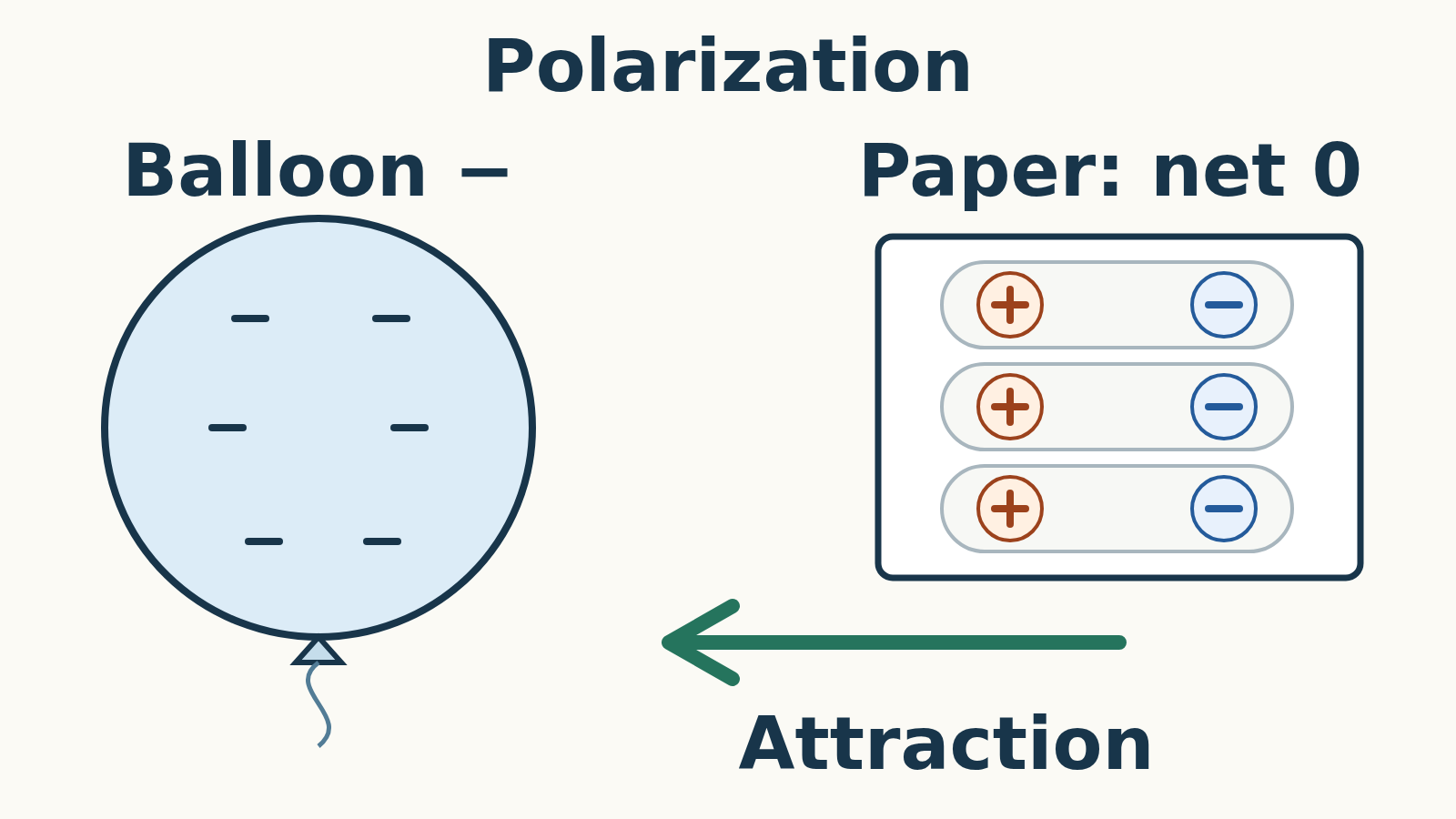
Why the paper moves toward the balloon
Unlike charges attract and like charges repel. In the diagram, the nearer positive charge is attracted, while the farther negative charge is repelled. The balloon’s electric influence is stronger closer to it, so these effects do not cancel: there is a net attraction toward the balloon.
The paper can still have zero net charge. It does not need to gain an overall positive charge before it moves. A positively charged object can also attract neutral paper; the polarization would have the opposite orientation.
Try a before-and-after comparison
Use an inflated, tied balloon, a dry woollen cloth and a few small pieces torn from a sheet of light paper. Work on a dry, smooth table away from draughts. An adult should inflate the balloon and supervise children. Keep uninflated balloons and broken balloon fragments away from small children; do not use a latex balloon if someone handling it has a latex allergy.
Before rubbing the balloon, bring it slowly toward the paper from above without touching. Stop moving your hand and watch. Record whether any piece moves. This is a comparison condition, not proof that the balloon has exactly zero charge.
Rub one area of the balloon with the cloth, then bring that area toward the same paper in the same way. Approach slowly and pause before contact. Look for movement while there is still a gap. Do not blow on the paper or sweep the balloon quickly over it.
Repeat the approach three times, rubbing again if necessary. Use fresh pieces if any paper touched the balloon. Record “moved before contact”, “moved only after contact” or “no clear movement” for each attempt. Also note any draught or accidental touch. Use a fresh line for each attempt so you can compare the outcomes.
What the comparison can tell you
Movement toward the rubbed balloon before contact is consistent with electrostatic attraction of polarized paper. Comparing slow, still approaches helps separate that effect from air pushed by a moving balloon. The observation alone does not measure charge or prove that the paper has the opposite net charge.
Once the paper touches the balloon, charge transfer may change what happens next. A piece may stick or later fall away. Do not use its behaviour after contact as a clean test of the original neutral-paper explanation.
An optional check with two balloons
Inflate two similar balloons and hang them on separate short threads so they can move freely. Keep threads away from necks and young children. Rub both with the same dry cloth, then bring the rubbed areas near each other without touching. Keep hands still and allow any swinging to settle.
Balloons charged in the same way can repel. In the simple model, they carry like net charges. This contrasts with attraction to neutral paper: attraction by itself cannot tell you that two objects have opposite net charges. Rubbing different materials does not always produce the same sign of charge.
If nothing happens
- Make the paper pieces lighter or smaller, and reduce draughts. Attraction must overcome the forces holding the paper in place before you see movement.
- Use dry materials and rub again. Damp air and moist surfaces can make static charge harder to retain; the result depends on the materials and conditions.
- Keep the rubbed area facing the paper and approach slowly. A fast sweep can move the paper with air instead.
- If a piece touched the balloon, set it aside and try another. Do not assume a touched piece is still neutral.
- If two balloons do not separate, check that the threads allow movement and that swinging or air currents are not masking it. An unsuccessful trial does not show that like charges attract.
Check the explanation
A charged balloon can attract neutral paper through polarization. Attraction alone does not establish opposite net charges.
Answers and explanations
- The paper is polarized but can remain neutral.: Yes. A small rearrangement of bound charges can give a net attraction without changing their total balance.
- The paper must first gain an opposite net charge.: That is not necessary. Polarization can attract a neutral object before contact.
- Neutral paper has no electric charges at all.: Neutral means equal total positive and negative charge, not an absence of charges.
What rubbing changes
For the usual school explanation of a rubber balloon rubbed with wool, electrons transfer between the materials, leaving a charge imbalance. Rubbing brings the surfaces into repeated contact; it does not create electric charge from nothing. The diagram chooses a negative balloon as one example, rather than a rule for every pair of materials.
Coru prepared the comparison sequence, illustration and question. The underlying electrostatic principles and balloon experiments are established science. The drawing exaggerates the tiny displacement of bound charges and does not show individual particles to scale.