Why is the sky blue, but sunsets red?
Air molecules scatter blue light more strongly than red. A blue sky shows light redirected toward you; a red sunset involves sunlight that has lost more blue along a longer path through air.
Start with the light that reaches you
“Blue light scatters more” seems to explain two opposite colours. In daytime, scattered light makes the sky blue. Near sunset, scattering leaves sunlight redder. The missing detail is which light you are following: light redirected out of a beam, or light continuing along it.
Sunlight contains a mixture of visible wavelengths. Blue wavelengths are shorter than red ones. Air molecules scatter the shorter wavelengths more strongly; this is called Rayleigh scattering. Red light also scatters, just less strongly. The atmosphere does not sort the colours into separate painted layers.
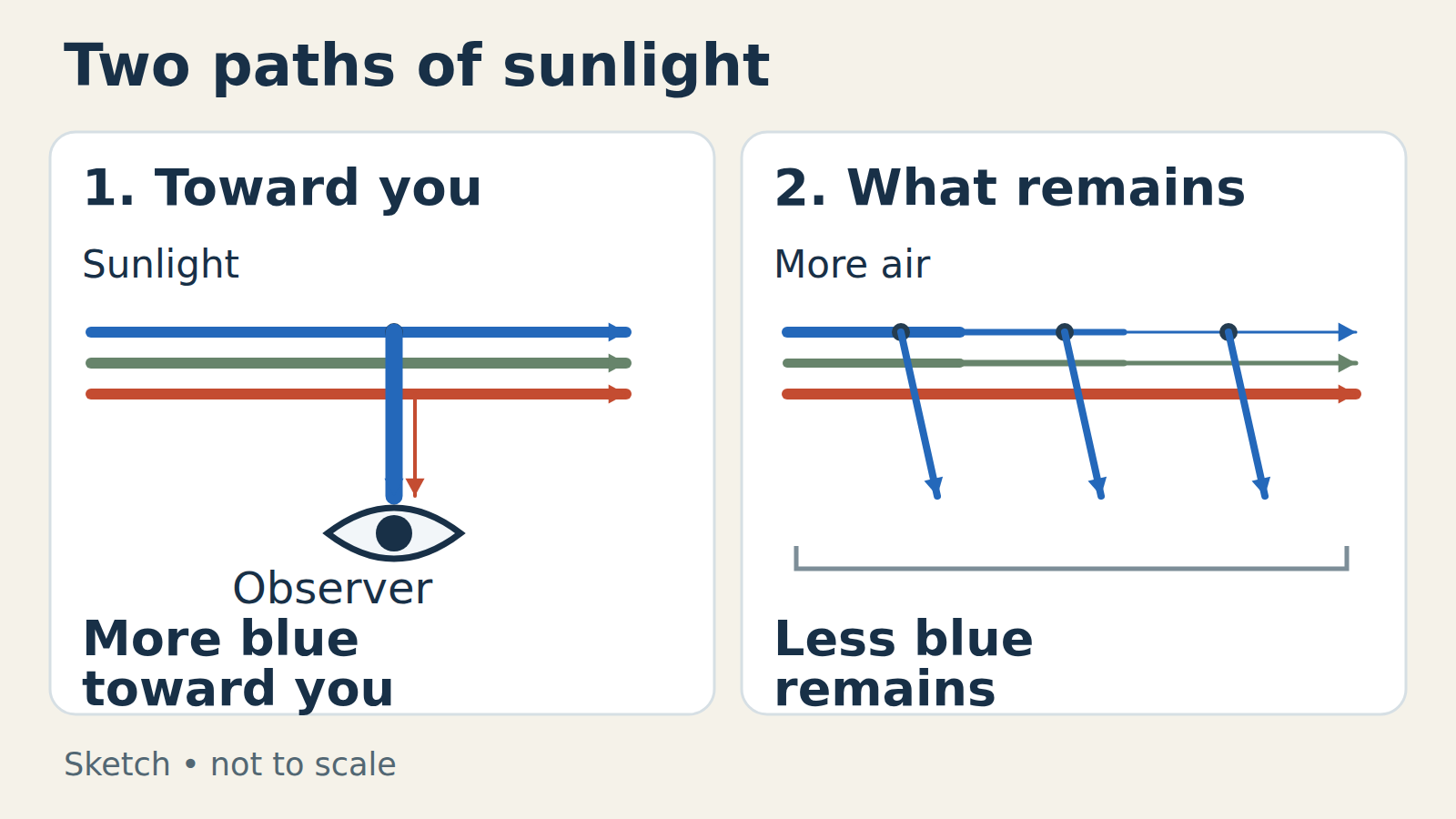
Path 1: light turns toward you
Imagine looking at a clear patch of daytime sky, away from the Sun. The light entering your eyes from that patch did not travel straight from the Sun to you. It first travelled toward the air above you, then some of it scattered in your direction.
That redirected mixture is richer in blue than the incoming sunlight, so the patch usually appears blue. Scattering sends light in many directions. Some scattered light reaches your eyes; much of it goes elsewhere. “Scattered away” therefore needs a reference: away from which original path?
Path 2: follow what remains in the beam
When the Sun is low, its light takes a longer, slanting route through the atmosphere than when it is high. Along that route, a larger fraction of the blue light is scattered out of the continuing beam. The remaining mixture can look yellow, orange or red.
This explains reddened direct sunlight. The glowing sky nearby is a further step: some of that already reddened light is scattered toward you. These are related paths, not the same path. The Sun’s disc and a patch of sunset sky are not interchangeable observations.
Blue light has not turned into red light. In this scattering model, the colours already present are redistributed among directions. Nor must all blue disappear everywhere: different parts of the sky involve different paths. A red horizon does not require the whole sky to be red.
Read the diagram as two different samples
On the left, follow the blue arrow leaving the incoming beam toward the observer. On the right, follow the beam that continues through more air. The blue branches leave that beam; the red line continues, while a thinner blue line shows that “less blue” need not mean “none”.
The arrows are a teaching sketch, not measured brightness, a scale drawing or individual photon tracks. The right panel stops at the remaining beam; scattering from that beam can then send reddish light toward a viewer of the sunset sky.
Why blue rather than violet?
Violet wavelengths are shorter still and scatter even more strongly. But perceived colour also depends on the sunlight’s spectrum and our eyes. There is less violet than blue in sunlight, and our eyes are less sensitive to violet. The daylight mixture therefore usually looks blue, not violet.
This is a useful clear-air explanation, not a complete prediction of every sky colour. Clouds, airborne particles and repeated scattering change the result. A particular evening may be cloudy or show little red; that alone does not contradict the model.
Compare two patches of sky safely
- On a clear day, stand in shade with the Sun completely hidden behind a building or another opaque object. Look at a patch of sky overhead and another nearer the horizon, away from the Sun. Never look directly at the Sun, including near sunset.
- Write three things for each patch: its position, its colour, and whether clouds or haze are visible. Later, repeat from a safe place with the Sun hidden. You may find paler blue, warmer colours or little visible change; record what you actually see.
- Use the two paths to describe a possible explanation. The comparison records appearances; it does not measure wavelengths or isolate molecular scattering from all other effects.
Follow the right light
Choose an explanation, or read the answer explanations below. The key is whether you follow scattered light or the remaining beam.
Answers and explanations
- Sky light is redirected toward us; the long-path beam loses more blue.: Yes. The daytime sky samples redirected light. A long atmospheric path leaves the continuing sunlight relatively richer in red; some of that light can then scatter toward a sunset-sky viewer.
- Blue light changes into red as it travels farther.: The model changes the directions of existing colours. It does not turn blue wavelengths into red wavelengths.
- Air stops scattering blue and starts scattering only red at sunset.: The scattering preference has not reversed. The longer route changes the colour mixture left in the beam.