Why does water climb a paper towel?
Water can wet a paper towel above the surface in the cup. Follow the wet front, measure from the right starting point and separate rise height from total absorption.
Water rises through a network of tiny spaces
Dip the bottom edge of an ordinary absorbent paper towel into water. The paper can become wet above the water surface even though that part never touched the water in the cup. This is capillary action.
Paper is made of fibres with many small, connected spaces between them. Water wets the fibre surfaces and advances through this network. The towel is not a bundle of identical straight tubes: its pore sizes, paths and fibre arrangement vary.
Adhesion, cohesion and surface tension work together
Adhesion is attraction between water and the solid surface; cohesion is attraction between water molecules. On a surface that water wets, these interactions make the water surface curve where it meets the solid. In the small spaces of paper, surface tension at these curved surfaces creates a pressure difference that can draw water onward and upward.
Gravity opposes upward movement, while resistance to flow slows the advancing water. For otherwise identical ideal wetting tubes, a narrower tube can support a higher water column. That does not mean a narrower passage always fills faster: it also offers more resistance to flow. A real towel adds a complicated pore network and evaporation, so a single-tube rule cannot predict its entire wetting pattern.
Try a five-minute observation
Use plain water, a stable cup, an ordinary paper towel, scissors, a ruler, a pencil or similar support and a clip. Put the cup on a tray. Cut a strip about 2 cm wide and 15 cm long. Keep its top dry and hold it vertically from the support; the lower end should hang freely without touching the cup’s side or bottom.
Fill the cup first, then lower the strip so that only about 5 mm of its lower end is immersed. Start a timer when the paper first touches the water. Fix the support at that position, keep the strip still and leave the upper part exposed to the air. Place the ruler beside the strip, outside the water.
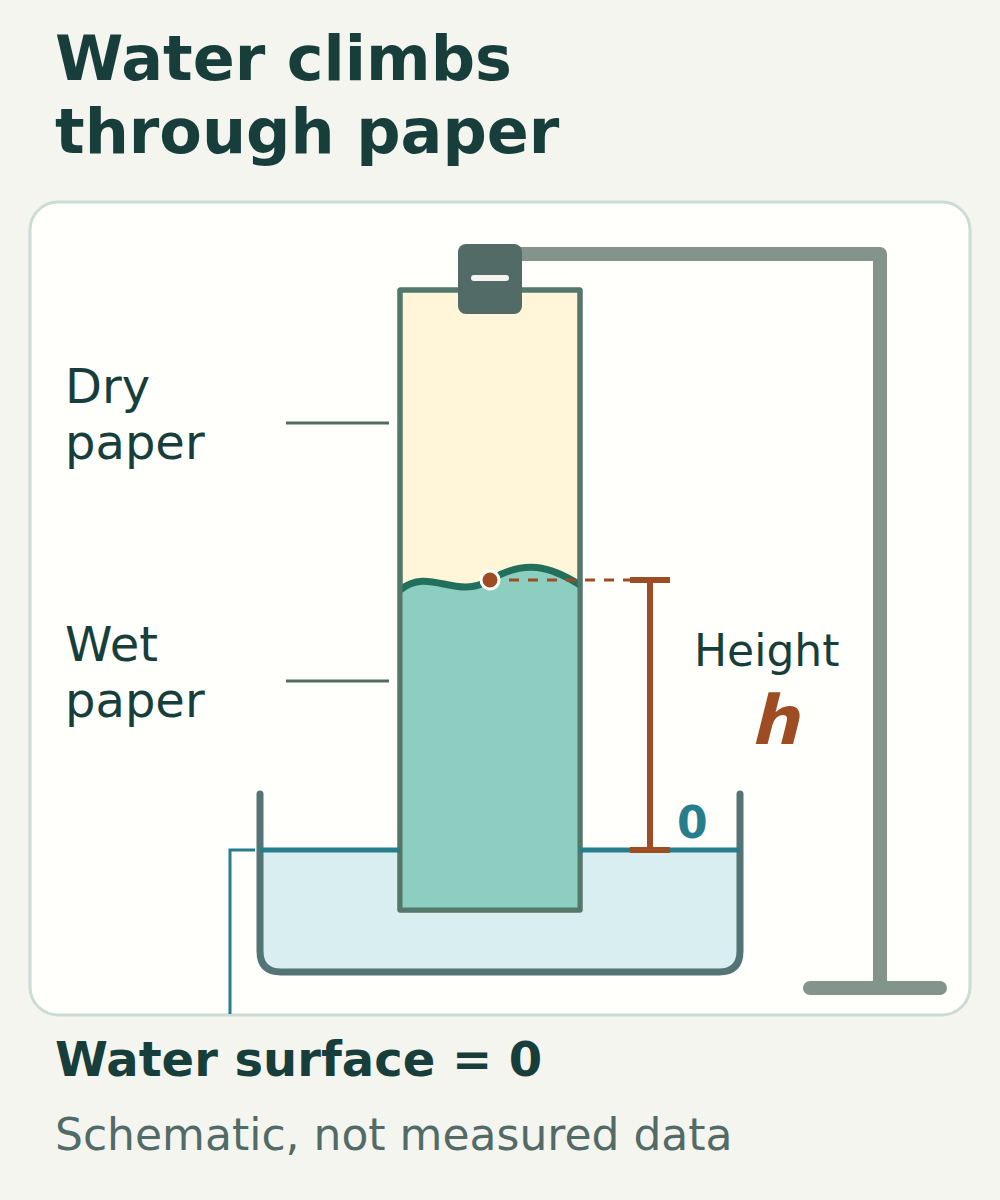
At 0, 30, 60, 120 and 300 seconds, record the height of the wet front above the water surface. Use the front at the centre of the strip each time, rather than switching to the highest wet patch. Read the water level again if it changes. These times are a recording schedule, not a prediction of how quickly your towel will wet.
If the boundary is fuzzy, record an approximate height or a range. If it reaches the top before five minutes, record the time and stop the height measurement: the strip has run out of length. Keep every observation, including no clear rise. Zero seconds marks first contact; if you cannot read a height then, mark it as missed instead of assuming zero. If a later reading is late, write its actual time. Do not fill the empty log with guessed results.
Copy this blank observation log
text
Paper / strip size / cut direction: __________
Time (s) | Height above water (mm) | Notes
0        |                        |
30       |                        |
60       |                        |
120      |                        |
300      |                        |
Measure from the water surface, not the bottom of the cup. Note an uneven front, a changing water level or contact with the cup.
What the wet front can tell you
A rising wet front shows that water is travelling through the paper above the reservoir surface. To compare speed over two intervals, divide each height gain by the time it took: the intervals in this log are not all equal. A short period with no visible movement does not prove that a final balance has been reached: your ruler may not resolve the change, evaporation may matter, or the paper may already be wet to the top. Even when the front stays still, water may continue flowing upward to replace water lost by evaporation.
The height is not the total volume of water absorbed. Two strips can have the same wet height but different thicknesses, pore space and amounts of retained water. To compare papers, use equal strip dimensions, the same immersion depth and recording times, and the same cut direction within each sheet. Repeat with fresh dry strips. Describe the result as a comparison of wet-front rise under those conditions.
If the result is hard to see
- Use side lighting to see the darkened wet paper. Plain water avoids confusing the water front with a dye that may travel differently.
- Check that the lower edge stays immersed. If it loses contact, the supply of water has changed.
- Keep the strip away from the cup’s sides and bottom. Contact can provide another route for water.
- Try a fresh strip of ordinary absorbent paper if a coated or water-resistant material does not wet readily. Record the material change.
- If the wet front reaches the top quickly, use a longer strip and begin a new run. The earlier run is still useful; it reached the limit of that setup.
What did you actually measure?
Choose the conclusion supported by the height measurement. Answers and explanations are available below, including without JavaScript.
Answers and explanations
- Water reached farther above the surface in A.: Yes. That is what the height measurement describes.
- A absorbed a greater volume of water.: Height alone cannot tell you the volume: the strips can differ in thickness, pore space and how much water they hold.
- A will always be the better towel for a spill.: Spill performance also depends on total uptake, speed, strength and the way the towel is used.
Why the water does not climb without limit
Capillary action does not switch gravity off. The weight of water matters as it rises, and flow through paper also depends on the paths available and evaporation. In plants, capillary effects are part of water behaviour, but capillarity alone is not a complete explanation of water transport to the crowns of tall trees.
The diagram is a schematic, and the log is deliberately blank. This activity lets you collect your own observations; it does not supply a measured rise height for an unspecified brand of paper.
Sources & further reading
- USGS: capillary action and water
- MIT: wettability and gravity
- Purdue University: surface tension and adhesion
- Imbibition with swelling: capillary rise in thin deformable porous media (primary study, PDF)
- M. A. Brazhnikov: capillary rise in blotting paper (Russian experiment)
- American Chemical Society: What is up with water? (PDF)