Why does water stay in a straw when you cover the top?
Cover the top of a straw containing water and lift it: much of the water can stay inside. The finger seals an air pocket above the water. A pressure difference supports the column, while surface tension helps keep the water–air boundary at the lower opening intact.
Try a sealed-versus-open comparison
Use a clean, ordinary narrow reusable plastic drinking straw, a stable cup of room-temperature water and a tray or sink. A clear straw makes the air pocket easier to see. Leave the top of the straw above the water. You do not need to suck or blow.
- With the top open, dip the straw into the cup, then lift it vertically over the tray. Notice how the water drains.
- Lower it into the water again. While its bottom is still submerged, cover the top tightly with a finger. Keep some air between your finger and the water.
- Lift the straw slowly, keeping it upright and sealed. Watch the lower end: a little water may escape before the remaining column settles.
- Hold the straw still above the cup and remove your finger. Compare the flow. Repeat using roughly the same starting water depth.
Record the change you actually see
For each trial, note “top open” or “top sealed”, then whether the water drains, drips briefly or remains for a short while. Check that your finger covers the whole opening without squeezing the straw. If water keeps escaping, try resealing the top before repeating. A wide smoothie straw may behave differently.
The air above the water still pushes
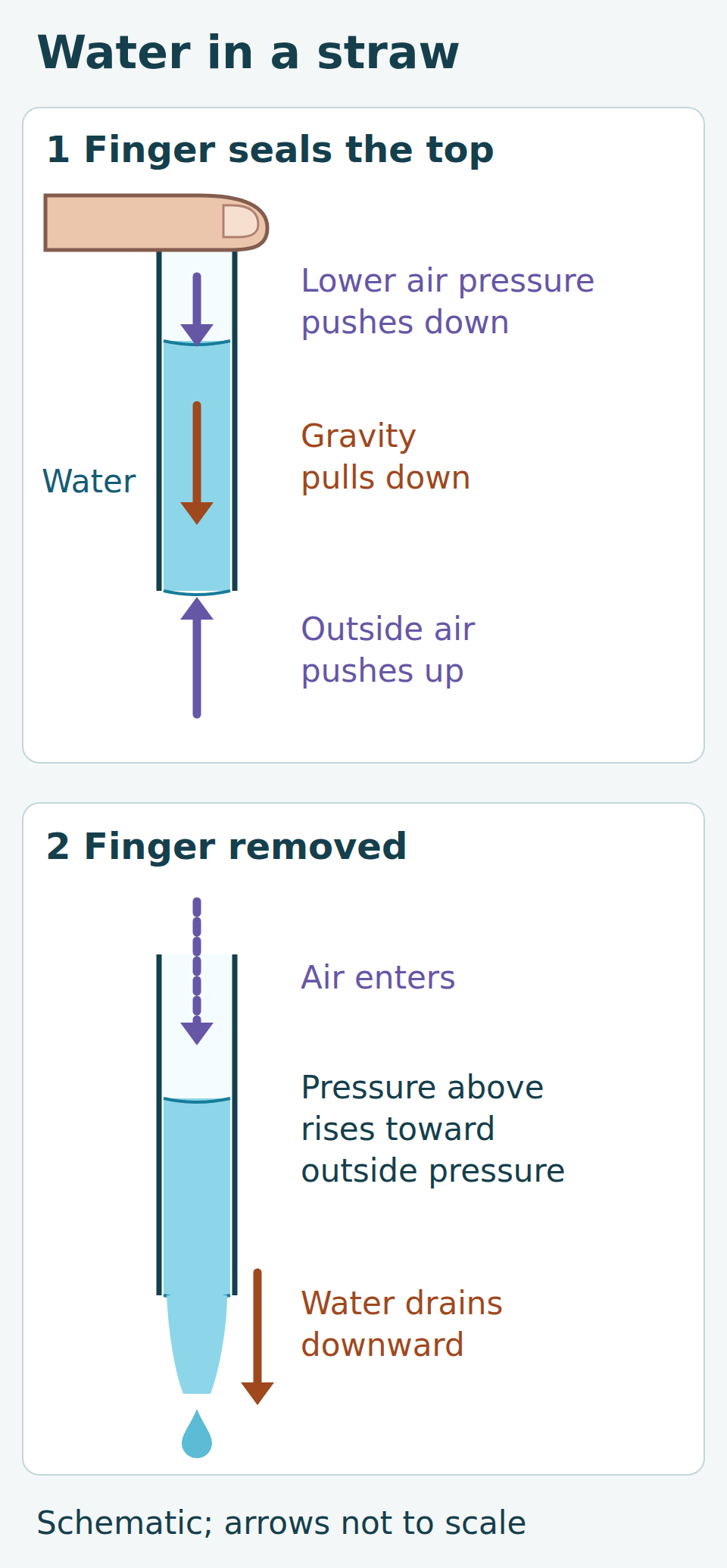
Gravity pulls the water down throughout the experiment. As the sealed straw is lifted, the water can move down slightly, enlarging the trapped air pocket. With no replacement air entering, the gas expands and its pressure drops. There is still air above the water; covering the top does not remove it.
Outside air pushes upward at the lower opening. The trapped air pushes downward at the top of the water, but less strongly. Once the column settles, the pressure difference provides the upward support needed against its weight. The finger maintains the seal; it is not gripping the water.
Why does removing the finger matter?
Outside air was already pressing at the bottom of the lifted, sealed straw. Uncovering the top does not switch that pressure off. It gives outside air a route into the upper pocket, so the pressure there moves toward the outside pressure. The supporting difference is lost and gravity drains the column.
Compare the pressures at both ends rather than saying only “air pushes up”. That upward push also exists with the top open. What changes is the pressure above the water.
Surface tension has a different job
At the lower opening, water meets air along a curved surface called a meniscus. Surface tension helps this boundary remain intact in a narrow straw, resisting air bubbles entering from below while water leaves. It is not a solid lid.
This is why a sealed top alone does not guarantee success with a much wider tube: the lower surface can break up, allowing air in and water out. Surface tension can also leave small drops or short plugs after the main column drains. Do not expect every last trace of water to disappear.
In this ordinary short-straw experiment, the pressure difference mainly supports the long water column; surface tension helps preserve the boundary. Water climbing through an absorbent paper towel is a related but different situation: there, curved surfaces within tiny wettable spaces draw water through the paper.
Diagnose a small leak
Choose an explanation, or open the answers below.
Answers and explanations
- Air enters above the water and reduces the supporting pressure difference: Yes. A finger can still touch the straw while failing to seal it. Incoming air raises the pressure in the upper pocket toward the outside pressure.
- The outside air suddenly stops pressing at the lower opening: The surrounding air is still there. The new route at the top changes the pressure above the water.
- Opening the gap makes the same water heavier: The water does not need to gain mass. Changing the balance of forces is enough to start it moving.
What this comparison establishes
The observation lets you connect the top seal with whether an ordinary straw retains water. It does not measure the pressure or isolate surface tension by itself. Keep the explanation within this short, narrow, upright straw setup; a different width, liquid or orientation can change the outcome.
Sources & further reading
- JSME: pressure support and surface tension in a straw
- Lou Bloomfield: how sealing a straw lets the pressure above the water fall
- Simon Fraser University: Fluids, slide 11 — forces on water in a sealed straw
- JSME: why short plugs can remain after water drains
- Purdue University: surface tension, meniscus and capillary action