Send a signal to Voyager. Come back tomorrow.
Light takes almost a day to reach Voyager 1. Send a symbolic signal now, save its link and return tomorrow: it will still be travelling — or will just have arrived.
Your signal in interstellar space
Without JavaScript, the table below still shows dates, distances and light travel times. Sending is only a simulation; no real message goes to the spacecraft.
If you send light right now
to reach Voyager 1This is a simulation. No real signal is sent to the spacecraft.
- Sent
- Reaches the spacecraft
- Earliest possible reply
Estimated times in your time zone. The reply is assumed to be instant; the real spacecraft does not answer this symbolic signal.
One spacecraft. Different clocks.
Geometric distance between Earth and the spacecraft at the same instant, divided by the speed of light. A travelling signal has to catch the moving spacecraft, so its travel time is slightly different. Values are rounded; dates use UTC.
| Date (UTC) | Distance, AU | Distance in light time |
|---|---|---|
| 2026-11-01 00:00:00 | 172.856 | 23 h 57 min 36 s |
| 2026-11-18 10:16:07 | 173.145 | 24 h 00 min 00 s |
| 2026-11-19 02:17:28 | 173.154 | 24 h 00 min 05 s |
| 2027-01-01 00:00:00 | 173.554 | 24 h 03 min 24 s |
| 2027-04-24 11:24:00 | 173.322 | 24 h 01 min 29 s |
| 2028-01-01 00:00:00 | 177.115 | 24 h 33 min 01 s |
| 2029-01-01 00:00:00 | 180.678 | 25 h 02 min 39 s |
| 2030-01-01 00:00:00 | 184.236 | 25 h 32 min 15 s |
| 2031-01-01 00:00:00 | 187.792 | 26 h 01 min 49 s |
The film
We made a Coru Short from this calculation: “Voyager 1 Is Now More Than a Light-Day Away. In January, Earth Starts Catching Up” (YouTube).
You pressed the button. Now wait
You can close this page, have lunch, go to bed and begin another day. Your signal keeps travelling. Arrival lets you look ahead; Now brings back the real clock. The link remembers the departure time, so you can open it tomorrow or send it to a friend.
This is a symbolic journey along a calculated trajectory, not a connection to the spacecraft. Nothing is transmitted. But the wait comes from the same distance and the same speed of light.
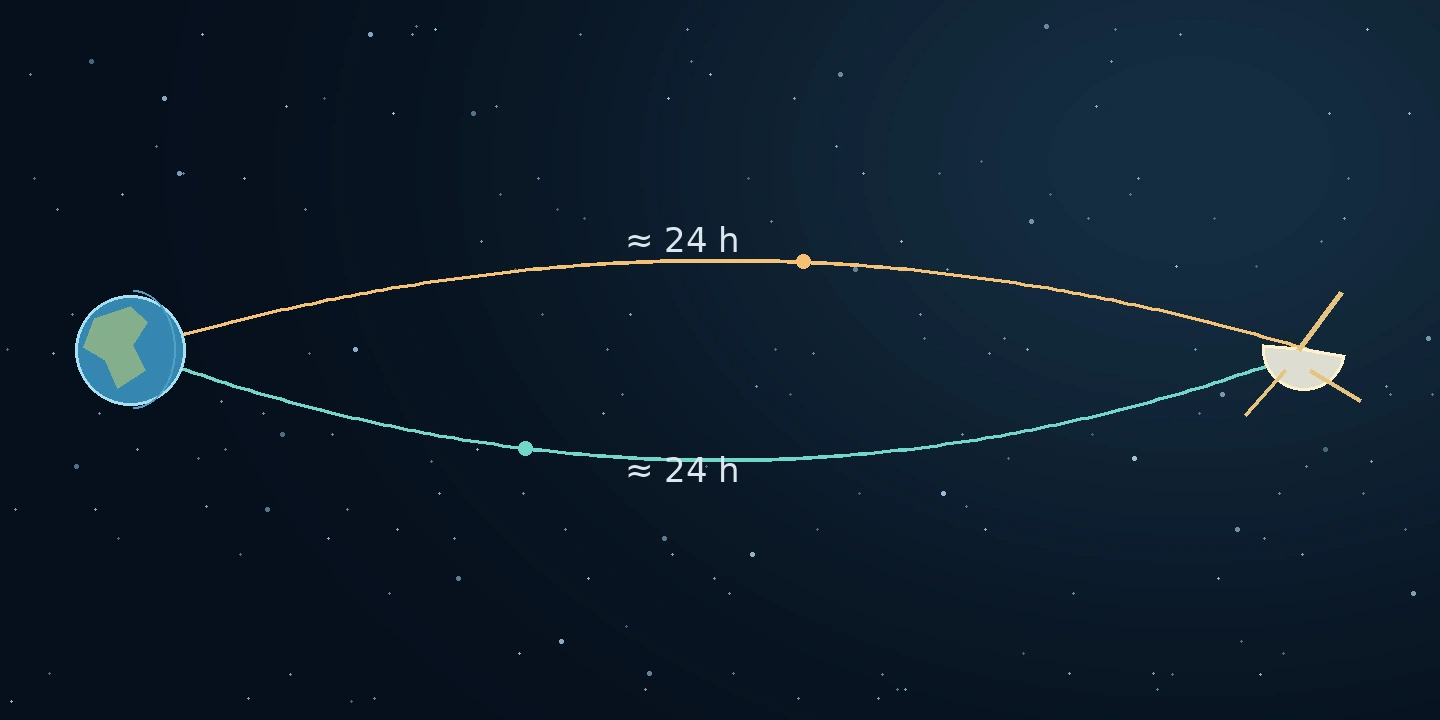
On 18 November, distance gains another unit
NASA puts Voyager 1’s one-light-day milestone at 10:16:07 UTC on 18 November 2026. That is about 25.9 billion kilometres: the distance light travels in 24 hours. Launched on 5 September 1977, the spacecraft has taken more than 49 years to reach somewhere light can get to in a day.
Why not exactly 48 hours?
Send a signal at that exact milestone and our model puts arrival at about 10:16:12 UTC on 19 November. An instant reply would reach Earth at about 10:16:21 UTC on 20 November: a round trip of 48 hours and 14 seconds. The light catches a moving spacecraft, then meets Earth at a different point in its orbit.
A third clock measures the journey of light reaching us now. That travel time reaches 24 hours at about 02:17 UTC on 19 November. A distance of one light-day, a command sent now and the reception of day-old light are three different events.
Voyager moves away. Earth sometimes gets closer
As Earth goes around the Sun, it alternately catches up with the spacecraft and falls behind. Our tables put the closest approach of 2027 around 24 April, at 173.322 astronomical units. Even then, the geometric distance exceeds a light-day by about 89 light-seconds. That checks the interval through the start of 2031; it is not a prediction for all time.
The real control room is elsewhere
NASA communicates with Voyager through its Deep Space Network. Here, the reply exists only in the model, with an ideal assumption: the spacecraft receives the signal and answers immediately. A real command needs an antenna, a scheduled contact and the mission team.
What makes these clocks tick
The positions of Earth and Voyager 1 come from JPL Horizons. Between table entries, the model uses both position and velocity, then solves for when light meets the moving receiver. It calculates the return journey separately. This is an estimate between Earth’s centre and the spacecraft, without atmosphere, hardware delays or the relativistic correction to the light path.
At 792 daily timestamps through the end of 2028, the calculated time of received light differs from the independent Horizons table by less than a millisecond. That checks the arithmetic; it does not promise that accuracy for future communications. The countdown also depends on your device’s clock. The arcs are a schematic, and Earth and the spacecraft are not to scale.