The triangle turned. Why didn’t the rulers move?
A circle can do this trick. But it has a rival with corners.
Turn it first
Imagine two parallel rulers pressed against opposite sides of a round coin. Turn the coin: the gap does not change. A square gives itself away almost immediately — it needs more room.
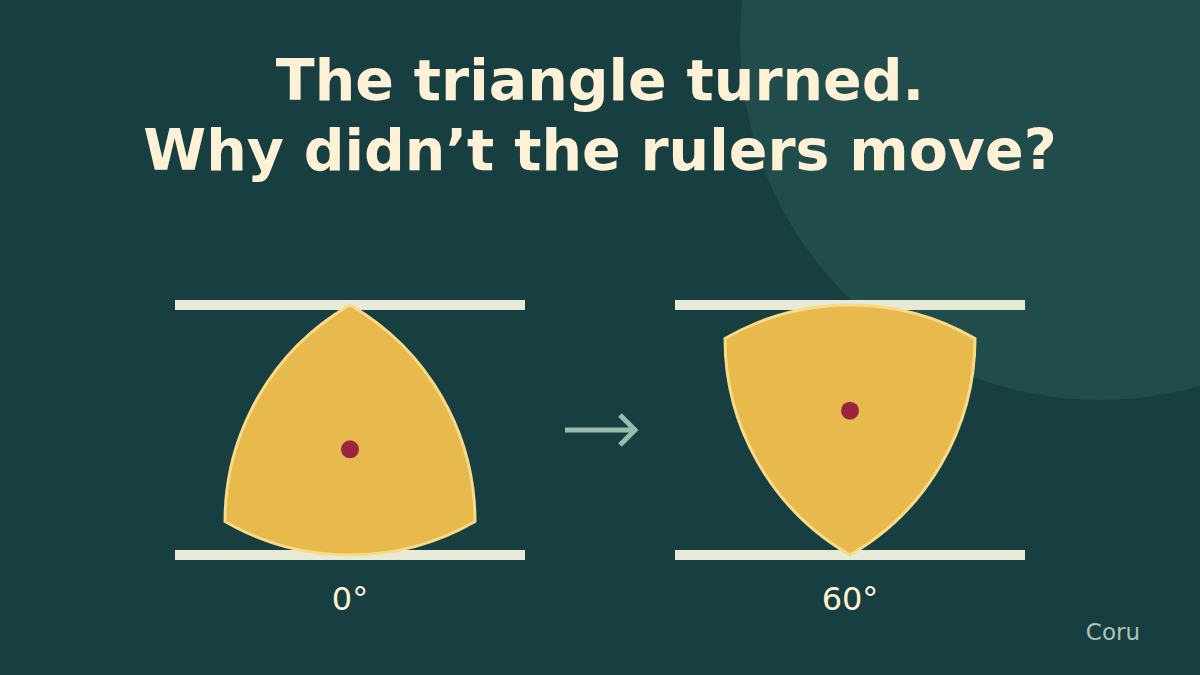
Now replace the circle with a curved “triangle”. It has three unmistakable corners. Before reading on, turn it by 30°, then once more. Watch the rulers first, and then the red dot.
Catch the changing width
Switch shapes and turn them with the slider or button. One unit is the circle’s diameter, the square’s side or the side of the starting equilateral triangle. Three still positions and an explanation follow.
- Gap between rulers
- 1.000
- Centre above the lower ruler
- 0.423
The lower ruler stays fixed. The shape turns and slides to keep touching it; the upper ruler follows the top. The dot marks the same centre throughout. This is a width comparison, not a rolling trajectory.
Three positions to compare
Three positions to compare
The curved triangle keeps a gap of 1.000 at every angle. Its centre changes height: about 0.423 at 0°, 0.500 at 30° and 0.577 at 60°. The square grows from 1.000 at 0° to about 1.366 at 30°. A constant gap does not mean a constant distance from the centre.
The rulers stayed. The dot moved
The Reuleaux triangle keeps the rulers one unit apart. Yet the red dot rises and falls. It marks the shape’s centre of rotational symmetry: the intersection of the medians of the starting equilateral triangle.
Try the square at 45°: its width grows to about 1.414 times its side. The circle behaves more quietly: the ruler gap equals its diameter, and its centre always sits halfway between them. The curved triangle shares the first property with the circle, but not the second.
The trick is built from three arcs
Start with an equilateral triangle. Put the point of a compass on one vertex, open it to another, and draw the short arc between the other two vertices. Keep the same compass setting and repeat at each vertex. Those three outer arcs form the boundary of the Reuleaux triangle.
Each arc belongs to a circle centred on the opposite vertex. When one ruler touches that vertex and the other touches its corresponding arc, the gap equals the construction radius. As the shape turns, contact passes to the next pair, but the radius stays the same.
Here, “width” means the distance between two parallel supporting lines touching opposite sides of the shape. It does not promise that every line segment through the middle has the same length.
A board above and an axle inside are different jobs
Make several identical cylindrical rollers with this cross-section and put a flat board on them. On a level surface, the geometry allows the board to stay at one height. The same roller width always separates the floor and board.
Now imagine attaching a load to an axle through the red centre instead. It rises and falls with the dot. You cannot simply substitute this shape for an ordinary wheel whose axle is fixed relative to a vehicle’s body: another supporting mechanism is needed.
Our diagram turns the shape and shifts it until it touches the lower ruler. It compares height and width at different orientations; it does not depict forward travel or rolling without slipping.
A similar compromise is already in someone’s pocket
British 20p and 50p coins have seven curved sides. The Royal Mint explains the design as a combination of a recognisable outline and a constant rolling diameter: the coins stand out from round ones, while their width suits coin mechanisms.
This is neither our triangle with four extra corners nor an ordinary straight-sided heptagon. The arcs are arranged to preserve the width as the coin turns.
Return to the red dot. The rulers ask, “How much space does the shape take up?” An axle asks, “At what height will I ride?” A circle makes those answers agree. A Reuleaux triangle pulls them apart.