You pick the die first. I still get the advantage.
I offer you first choice. Every number is visible in advance, and the dice are fair. Why is this less generous than it sounds?
Take any die. The numbers are already fixed.
Choose any die. I’ll reveal my reply—and why it wins more often.
Which die is yours?
After you choose, I take one of the remaining dice. We would then roll once each: the higher number wins. Different dice in this set cannot tie.
Our model: each die is fair, all six faces are equally likely, and the rolls are independent. Repeated numbers occupy separate faces.
A: 0 · 0 · 4 · 4 · 4 · 4
B: 3 · 3 · 3 · 3 · 3 · 3
C: 2 · 2 · 2 · 2 · 6 · 6
D: 1 · 1 · 1 · 5 · 5 · 5
You have A. I take D.
D has three fives: each beats every face of A. That is 3 × 6 = 18 outcomes. D’s three ones beat only A’s two zeroes: another 3 × 2 = 6.
My D wins in 24 of the 36 equally likely outcomes: a 2/3 chance. Your A wins in the other 12: a 1/3 chance. We have not rolled yet—you could certainly win.
You have B. I take A.
Your B always rolls three. A has four fours and two zeroes. A four wins; a zero loses.
My A therefore wins in 4 × 6 = 24 of the 36 equally likely outcomes: a 2/3 chance. Your B wins in the other 12: a 1/3 chance. A reliable three is still vulnerable to a four.
You have C. I take B.
Those sixes look impressive. But four faces of C show 2. My B always rolls 3 and beats every one of those four faces.
My B wins in 6 × 4 = 24 of the 36 equally likely outcomes: a 2/3 chance. Your C wins in the other 12: a 1/3 chance. A large possible score and a frequent win are different things.
You have D. I take C.
C’s two sixes beat all six faces of D: 2 × 6 = 12 outcomes. C’s four twos beat D’s three ones: another 4 × 3 = 12.
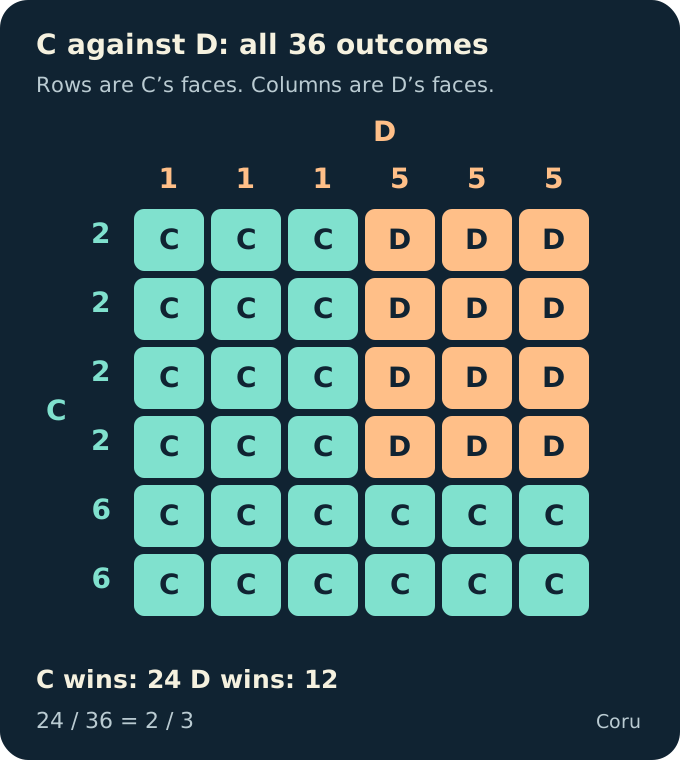
My C wins in 24 of the 36 equally likely outcomes: a 2/3 chance. Your D wins in the other 12: a 1/3 chance. You can count every cell of this matchup below.
There ought to be a strongest die. There isn’t.
If A usually beats B, and B usually beats C, it is tempting to rank A above C and keep going. Here the ranking closes into a ring: A usually beats B, B beats C, C beats D, and D beats A. In each of those four directed matchups, the first die has a 2/3 chance of winning.
These are Efron’s dice. “Nontransitive” means you cannot pass the advantage along a chain. Think of rock–paper–scissors, except that chance decides the winner of an individual round.
No lucky demonstration. All 36 cases.
Take C against D. Each row in the grid is a separate face of C; each column is a separate face of D. Repeated numbers appear again because they occupy distinct, equally likely faces. Each cell names the die with the higher score.
In the four rows of twos, C beats only D’s ones: 4 × 3 = 12 cells. In the two rows of sixes, C beats everything: 2 × 6 = 12 cells. Together that is 24 out of 36, or 2/3.
What if you choose by the average?
C has the highest average score in the set: (2 + 2 + 2 + 2 + 6 + 6) / 6 = 10/3. B averages only 3. Yet B beats C with probability 2/3.
The sixes raise C’s average, but a win by a huge margin still counts as one win. We are comparing how often a die wins, not how many points it scores in total.
Now swap places
You can try this with two ordinary dice. Use your chosen letter’s six-number list as a lookup table: roll 1 and take the first number; roll 2 and take the second; and so on. Each player rolls their own ordinary die independently. No relabelling required.
Over a short run, the player with a 1/3 chance may win more often. A 2/3 probability promises neither the next roll nor exactly two wins in three attempts.
Now offer a friend first choice. Then let them choose second instead. The numbers stay the same. The advantage travels with the right to reply.